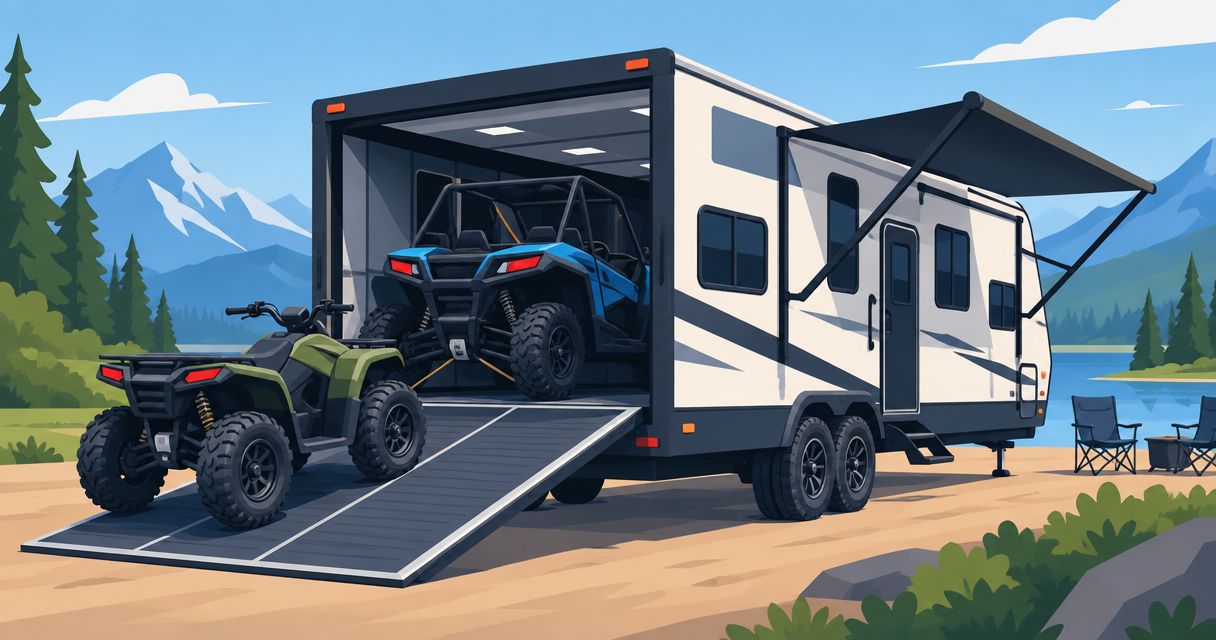
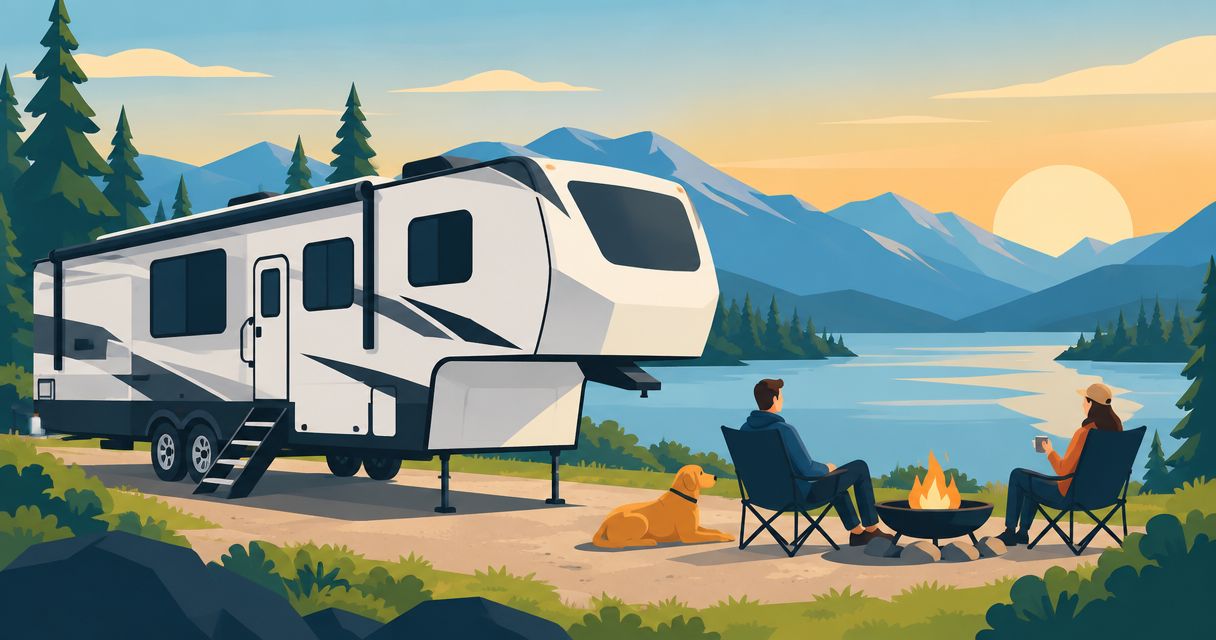
Best overall for full-time RV living in 2026: a rear-living fifth wheel. Best for a household that needs a separate room: a mid-bunk fifth wheel. Best for carrying bulky gear: a toy-hauler fifth wheel. If you are shopping near Myrtle Beach, Recreation USA sells new and used fifth wheels and can help you compare layouts against your truck and daily routine.
- The best fifth wheels for full-time living start with a rear-living layout for most buyers.
- Choose a mid-bunk fifth wheel when a separate room matters more than open living space.
- Choose a toy-hauler fifth wheel for bulky gear, but check what garage space takes from the living area.
- Recreation USA is a local option for comparing new and used fifth wheels near Myrtle Beach.
Why this matters
A fifth wheel can feel spacious during a walkthrough and cramped after your clothes, cookware, work supplies, and outdoor gear move in. For full-time living in 2026, the best layout is the one that still works when everyone is inside on a rainy day. Choose for your ordinary day, not your favorite campsite.
Start with the truck. A floorplan does not fix an unsuitable tow match, and a truck badge alone does not establish what your particular vehicle can carry or tow. Check the truck's ratings, the fifth wheel's loaded weight information, and the hitch setup before treating any layout as a finalist.
Recreation USA is a family-owned dealership with 2 lots in the Myrtle Beach area. It sells new and used RVs and offers financing, trade-ins, parts, and service. Those are useful conversations to have while you compare fifth wheels, but none replaces checking the particular RV and tow vehicle you plan to use.
What makes the best fifth wheel for full-time living?
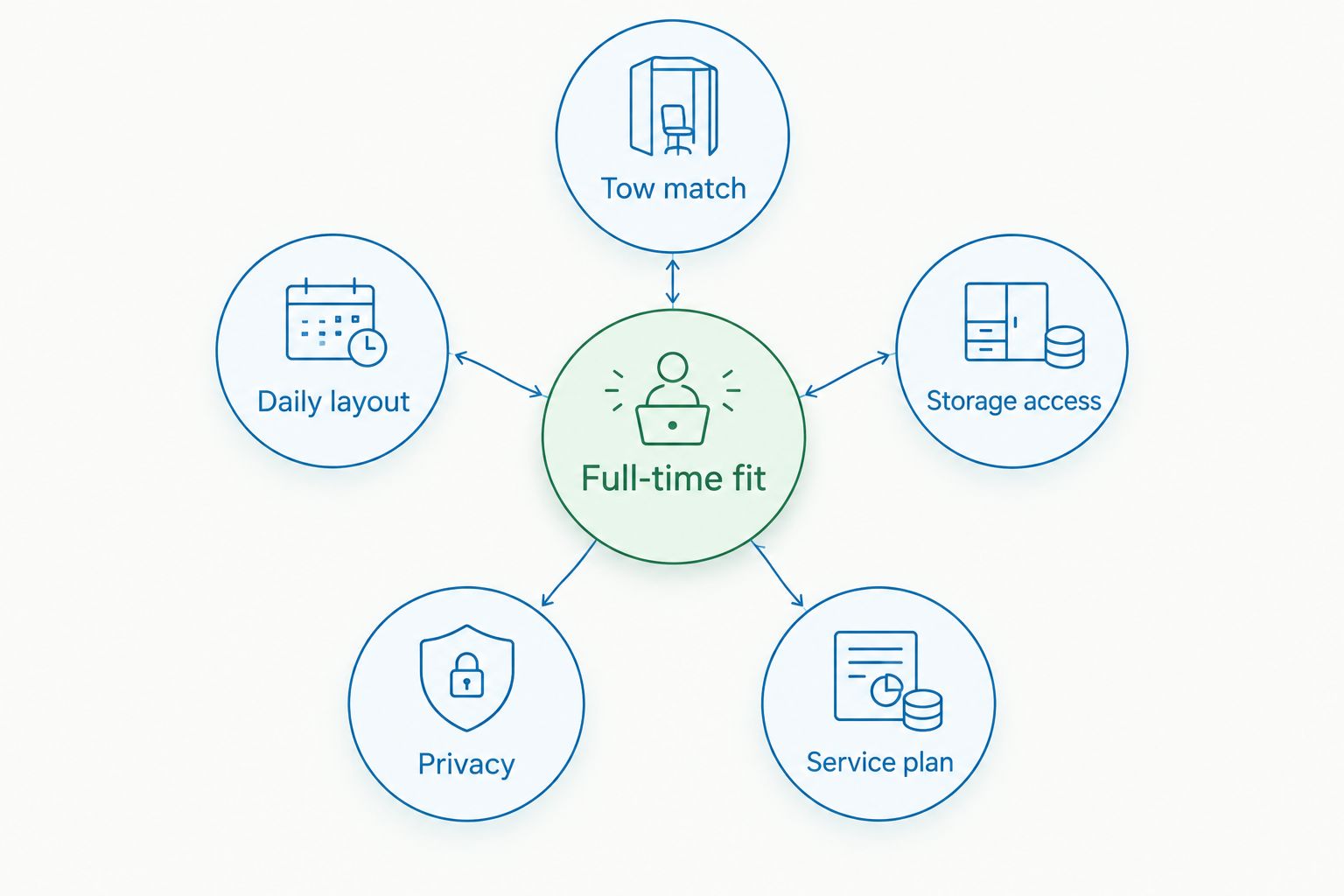
Use these criteria before the ranking. A layout that fails a daily need should not win because it looks better in photos.
- Tow match: Verify the truck's actual ratings against the fifth wheel and its expected loaded configuration. Include what you will carry in the truck as well as the RV.
- Daily layout: Walk through cooking, working, bathing, relaxing, and sleeping. Check whether 2 adults can do different activities without constantly moving around each other.
- Storage access: Look inside cabinets and exterior compartments. Storage is less useful if everyday items are hard to reach once the RV is packed.
- Privacy: Decide whether you need a door between people who keep different schedules or whether an open common area serves you better.
- Service plan: Ask how you will handle inspections and repairs while the RV is your home, including where you would stay if work takes the RV out of use.
These checks define full-time fit. They matter for a new fifth wheel and for a used one; a favorable layout cannot cancel out an unresolved tow or condition question.
Best fifth wheels for full-time living at a glance
These are layout types, not model endorsements. Manufacturers arrange the same general layout in different ways, so inspect the actual fifth wheel before deciding.
| Fifth-wheel layout | Best for | Standout feature | Key limitation |
|---|---|---|---|
| Rear living | Most buyers without a separate-room requirement | Open common area | Less privacy for a second activity |
| Mid-bunk | Households needing a separate room | Enclosed flex space | Bunk room takes floor space from elsewhere |
| Rear kitchen | Buyers who cook often | Dedicated kitchen zone | Kitchen placement may reduce rear seating choices |
| Front living | Buyers who separate lounging from sleeping | Distinct living area | More interior transitions to assess |
| Toy hauler | Buyers carrying bulky gear | Garage space | Garage competes with conventional living space |
A used rear-living fifth wheel belongs on the shortlist if you are weighing value, but used is not automatically the better buy. Condition, maintenance needs, and suitability matter more than the label. Compare actual units rather than assuming every floorplan with the same name feels alike.
1. Rear-living fifth wheel: best for an open everyday living area
Best for: A couple or solo traveler who wants the main living area to handle meals, conversation, and downtime. This is the default layout to view first in 2026 because its open common area makes daily movement easy to judge during a walkthrough. It is not the default if someone needs an enclosed room for work, sleep, or quiet.
Sit where you would relax, then have another person use the kitchen. Open cabinets, stand at the counter, and see whether both people can move without negotiating the same narrow spot. If you work inside the RV, identify where a laptop and supplies would live after work ends; a dining surface is not automatically a satisfactory desk.
Rear-living fifth wheel pros:
- An open common area makes it easier to assess daily circulation.
- Seating and kitchen access can be evaluated together during a walkthrough.
- It is a clear starting point when you do not need a separate flex room.
Rear-living fifth wheel cons:
- A shared room offers limited separation for different schedules.
- A visitor or remote worker may have no enclosed space away from the main activity.
- An open look does not prove that the storage fits your belongings.
Verdict: Buy a rear-living fifth wheel when the tow match checks out and the actual unit gives you enough storage and usable living space. Hold if either person needs a door between work and relaxation.
2. Mid-bunk fifth wheel: best for a separate flex room
Best for: A household that needs an enclosed room for a child, guest, work setup, or a different sleep schedule. A mid-bunk layout gives that requirement its own place in the decision. Do not count a room as flexible until you have checked its door, usable floor area, storage, and access with your belongings in mind.
Start by assigning a real purpose to the room. If it is for remote work, picture calls while someone else cooks. If it is for sleeping, check what remains usable when bedding and personal items are in place. Then return to the main living area and ask what space the extra room has taken away.
Mid-bunk fifth wheel pros:
- A separate room can protect privacy during shared full-time use.
- The room can give recurring activities a fixed place.
- It helps you evaluate household needs rather than just total open space.
Mid-bunk fifth wheel cons:
- The extra room competes with kitchen, seating, or storage space.
- A room that looks useful while empty may not suit its intended task.
- It adds little value if your household rarely needs separation.
Verdict: Buy a mid-bunk fifth wheel if you can name a daily job for the room and the rest of the RV still works. Skip it if you are trading away useful common space for a room you will seldom occupy.
3. Rear-kitchen fifth wheel: best for frequent cooking
Best for: A full-time buyer who prepares meals regularly and wants to judge the kitchen as a working space, not a decorative feature. In 2026, a good kitchen decision still comes down to where you put ingredients, prepare food, wash up, and store cookware. Check each task in the actual floorplan.
Stand at the counter and trace a normal meal from storage to cleanup. Open the drawers you would use most. Have another person pass through while you are in the cooking position; a kitchen that works for 1 person can feel different when 2 adults share the RV.
A rear kitchen also changes what happens at the back of the fifth wheel. If rear-facing seating is your priority, compare that trade-off directly rather than assuming a kitchen you like makes up for it.
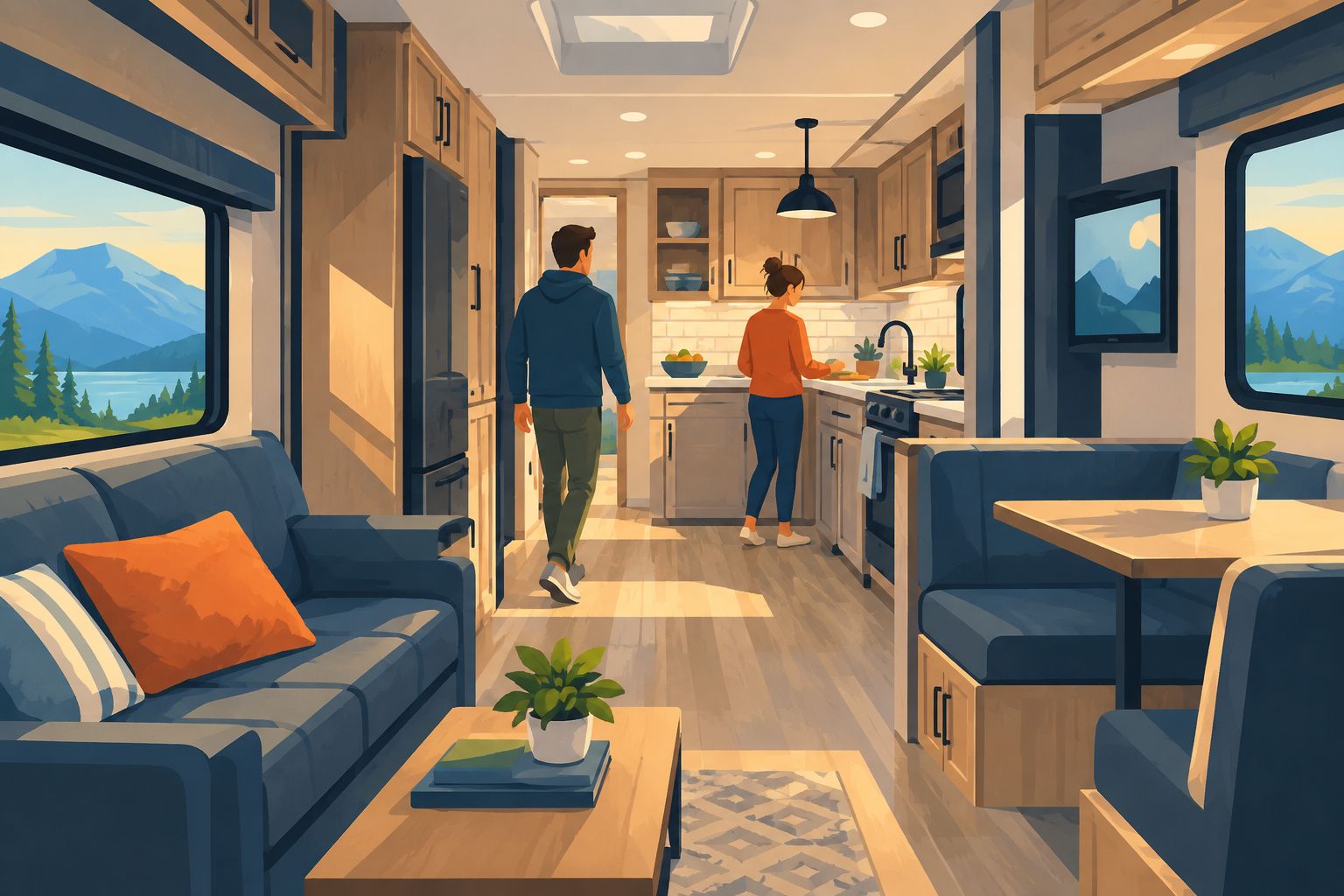
Rear-kitchen fifth wheel pros:
- It puts kitchen workflow at the center of your walkthrough.
- It gives frequent cooks a distinct layout to compare with rear living.
- Storage and counter access are straightforward to test in person.
Rear-kitchen fifth wheel cons:
- The kitchen occupies space another layout might use for seating.
- A convenient-looking counter does not guarantee adequate storage.
- Passing traffic may interfere with cooking in a particular floorplan.
Verdict: Buy a rear-kitchen fifth wheel when cooking is a daily priority and the actual unit passes your storage and circulation checks. Hold if lounge seating matters more.
4. Front-living fifth wheel: best for distinct lounging space
Best for: Buyers who want lounging to feel separate from the bedroom and kitchen. A front-living layout gives you a different way to organize the day: one area for sitting together, another for cooking and meals. That distinction is useful only if moving between the spaces feels natural to everyone who will live there.
Walk the route you would take repeatedly: bedroom to bathroom, bathroom to kitchen, kitchen to seating. Notice steps, doorways, and places where two people would meet. Then sit in the lounge and check whether it serves your real activities, including reading, conversation, or work, rather than just looking impressive on a tour.
Front-living fifth wheel pros:
- It gives lounging a defined place apart from other activities.
- It provides an alternative when rear-living layouts feel too open.
- It makes room-to-room movement an explicit part of the decision.
Front-living fifth wheel cons:
- More distinct areas mean more transitions to evaluate.
- A lounge-focused plan can leave less room for another priority.
- The arrangement is a poor fit if you prefer one open common area.
Verdict: Buy a front-living fifth wheel when the separated lounge improves your normal day and the walking routes work. Skip it when the layout adds complexity without solving a need.
5. Toy-hauler fifth wheel: best for bulky gear
Best for: Buyers whose gear needs dedicated space inside the RV. A toy-hauler fifth wheel earns its place on this list because full-time living is also about where equipment goes when you are not using it. The garage must justify the conventional living space it replaces.
List what you intend to carry and where each item will go. Then check the actual unit's documented carrying limits, access, and layout with that load in mind. Do not assume that a garage makes every item suitable to transport or that an empty garage will work as a bedroom or office without checking how the specific space functions.
Toy-hauler fifth wheel pros:
- It gives bulky belongings a dedicated area to assess.
- It separates gear decisions from kitchen and bedroom storage.
- It suits buyers whose equipment is central to their travel plans.
Toy-hauler fifth wheel cons:
- Garage space competes with a conventional living area.
- Carrying gear makes the tow and load checks especially important.
- The garage may be wasted space when the gear is elsewhere.
Verdict: Buy a toy-hauler fifth wheel when the gear has a clear purpose and the loaded tow match works. Skip it if a rear-living or mid-bunk plan better serves your everyday life.
How these layouts rank
The order reflects daily usefulness for a full-time buyer without a stated requirement for a separate room, dedicated cooking zone, or garage. That is why rear living ranks first. Once you have one of those requirements, the matching layout moves ahead of the default; no floorplan wins independently of your truck, household, and actual unit condition.
For used fifth wheels, inspect condition before treating layout as the deciding factor. Ask what has been maintained, examine signs of water intrusion, and have the systems and structure assessed as part of your purchase decision. For any fifth wheel, confirm the tow match using the particular truck and RV rather than a floorplan category. Recreation USA offers new and used fifth wheels, trade-ins, financing, parts, and service near Myrtle Beach, so buyers can raise those ownership questions while shopping.
Compare fifth wheels near Myrtle Beach
Discuss new and used layouts, towing questions, trade-ins, and service with a local dealership.
Which fifth wheel should you choose in 2026?
Start with a rear-living fifth wheel if you have not identified a specific need for another layout. It gives you a baseline for judging common-area space, storage, and how 2 adults move around the RV. If privacy is non-negotiable, view a mid-bunk next; if cooking drives your routine, compare a rear kitchen.
Bring the truck details and a list of what you will carry. At each RV, repeat the same walkthrough: sit, cook, open storage, use the bathroom, and trace the path to bed. Comparing those tasks across units tells you more than comparing brochure descriptions. Before agreeing to a purchase, resolve the tow match, inspect the actual RV, and ask how service would work while you live in it.
FAQ
What is the best fifth wheel for full-time living in 2026?
A rear-living fifth wheel is the best starting point for most full-time buyers in 2026. Choose a mid-bunk instead if your household needs a separate room, and confirm the actual RV fits your truck and routine.
Is a mid-bunk fifth wheel better than rear living for full-time use?
A mid-bunk fifth wheel is better when you will use its separate room regularly. Rear living is the stronger starting point when open common space matters more than privacy.
Is a rear-kitchen fifth wheel good for full-time living?
A rear-kitchen fifth wheel is a good fit when cooking is a daily priority. Test counter access, storage, and walking space in the particular unit before choosing it.
Should I buy a used fifth wheel for full-time living?
Buy a used fifth wheel when its condition, tow match, and layout meet your needs. Inspect the actual RV and assess maintenance needs rather than assuming used is automatically the better value.
Can I use a toy-hauler fifth wheel as a full-time home?
Yes, if its garage serves a real need and the remaining living space works for you. Check the particular RV's load information and your truck's ratings with the gear you intend to carry.
What should I check before towing a fifth wheel?
Check the ratings for your specific truck, the fifth wheel's weight information, and the hitch setup. Account for passengers and cargo as well as what you plan to carry in the RV.
Where can I compare new and used fifth wheels near Myrtle Beach?
Recreation USA sells new and used fifth wheels at its Myrtle Beach-area dealership. Bring your truck details and ask to compare layouts, trade-in questions, financing, and service.
One last thing
In 2026, the most useful fifth-wheel tour is the one where you stop admiring the empty floorplan and act out a normal day. Open the cabinet you would use every morning, stand where you would cook, and sit where you would spend a rainy afternoon. If the layout fails that test, keep looking.