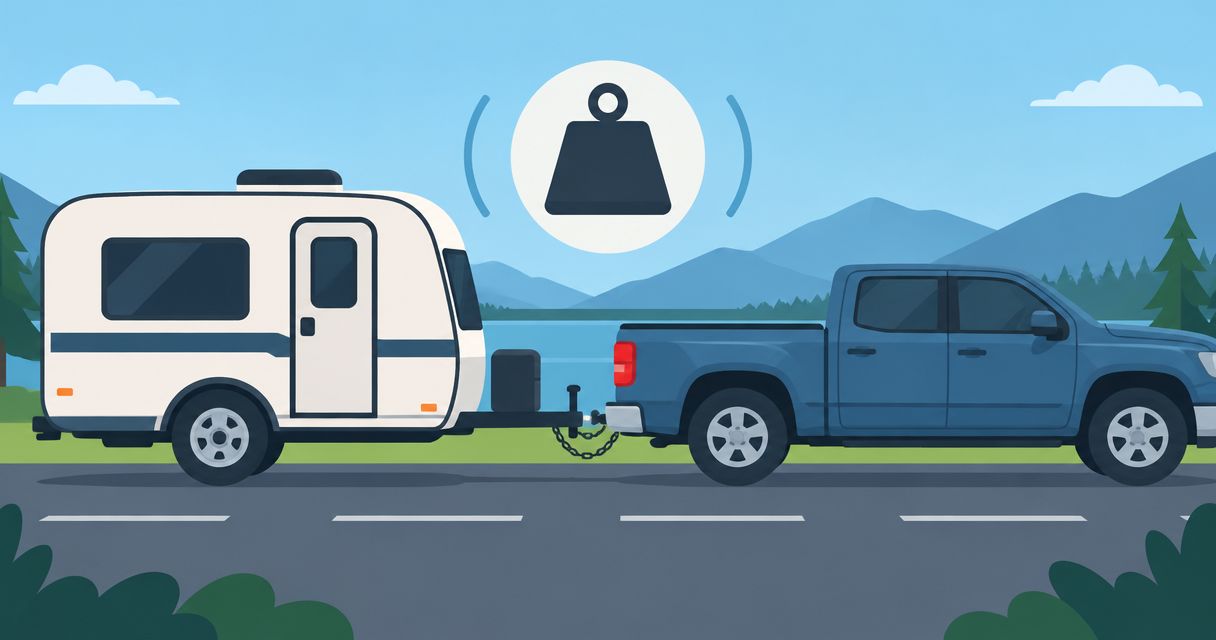
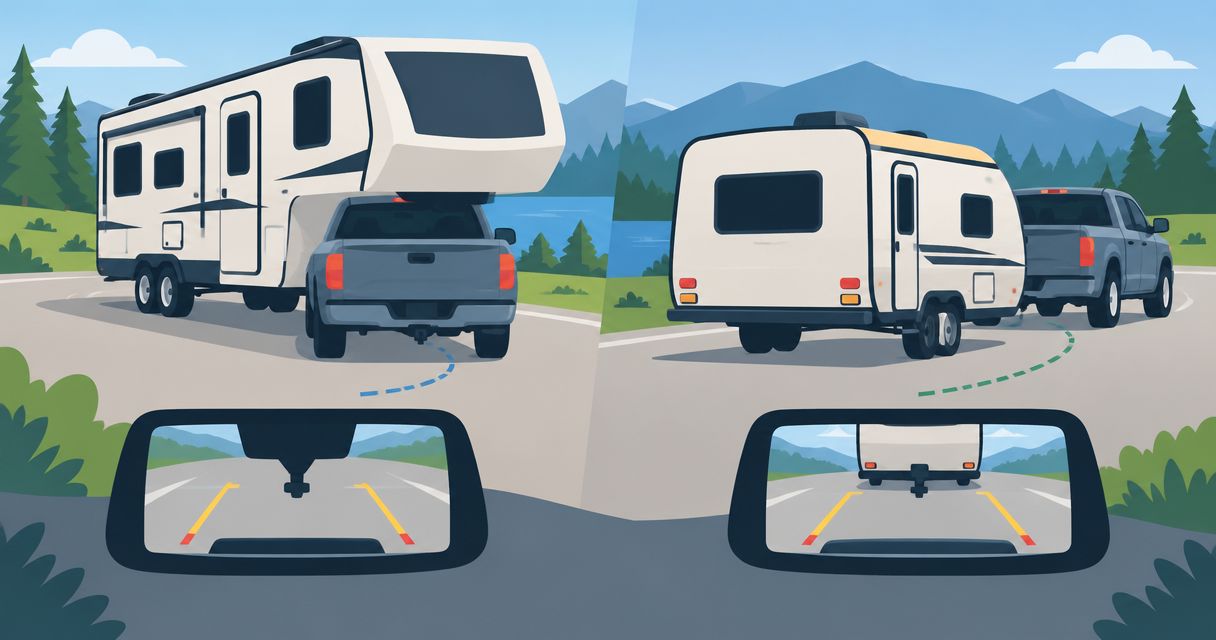
No—a fifth wheel is not inherently harder to back up than a travel trailer, but its different pivot point changes how you steer and time your corrections. A fifth wheel generally takes longer to start changing direction than a comparable bumper-pull trailer, so waiting for movement and then adding more steering can leave you correcting too late. Your truck, trailer dimensions, campsite approach, and practice matter more than the trailer category alone.
- Is a fifth wheel harder to back up? Not inherently; hitch geometry changes steering response and correction timing.
- Fifth wheels require attention to truck-cab clearance; travel trailers require attention to hitch angle and rear swing.
- Choose your truck-and-trailer combination by towing limits, campsite access, and floorplan—not backing reputation alone.
- Recreation USA serves Myrtle Beach-area buyers comparing new and used travel trailers and fifth wheels.
A camera helps you see behind the camper, but it does not show every clearance. Review how to connect a backup camera to your truck and travel trailer as a visibility aid, not a replacement for checking outside.
Is a fifth wheel harder to back up than a travel trailer?
Neither trailer type is automatically easier to park. A fifth wheel pivots at a hitch in the truck bed, while a travel trailer pivots at a ball behind the tow vehicle’s rear axle. That difference changes how the trailer responds when you reverse.
| Backing consideration | Fifth wheel | Travel trailer |
|---|---|---|
| Pivot location | Hitch in the truck bed, positioned according to the approved installation | Hitch ball behind the rear axle |
| Initial response | Generally requires more truck movement before the trailer changes direction | Generally responds sooner to steering input |
| Main correction habit | Avoid adding steering while waiting for a response | Avoid chasing quick changes with large corrections |
| Contact points to watch | Trailer front cap, truck cab, bed rails, and tailgate | Trailer body, tow vehicle, hitch equipment, and tongue-mounted equipment |
| Best for | Buyers with a compatible truck who prefer the fifth-wheel layout | Buyers whose compatible tow vehicle and camping plans suit a bumper-pull layout |
| Main drawback | Truck-bed hitch requirements and cab-clearance checks | Rear-mounted pivot can make steering corrections feel more immediate |
The comparison still depends on the actual equipment. A short travel trailer can react quickly, while a longer trailer requires more room to position. A familiar trailer is often easier to place than an unfamiliar one, regardless of hitch type.
Why this matters
Buying a camper because someone says it is easy to back up skips the more important question: does the complete rig fit your truck, your driveway, and the campsites you use? A comfortable living space does not solve a narrow approach or an incompatible towing setup.
For a 2026 purchase, compare the actual truck and camper rather than assuming a newer model changes the basics of reversing. First-time buyers need a repeatable method; experienced owners changing trailer types need time to relearn the response.
Backing a fifth wheel: wait for the response
A fifth wheel’s hitch location changes the relationship between truck steering and trailer movement. Compared with a similar bumper-pull setup, you generally move the truck farther before seeing the trailer turn. The mistake is treating that delay as a reason to keep adding steering.
Once the trailer begins turning, start bringing the truck back into alignment before the angle becomes difficult to recover. Use a small input, watch the result, and correct early. Stacking several steering changes together makes it harder to understand which movement caused the trailer’s current path.
The advantage is not permission to turn as sharply as possible. Fifth-wheel owners must watch clearance between the trailer’s front cap and truck cab, plus clearance around bed rails and the tailgate. Follow the hitch, truck, and trailer manufacturers’ instructions for the specific combination.
If the truck or hitch has an adjustment or maneuvering feature, learn its operating instructions before approaching a tight site. Do not assume that equipment advertised for maneuvering removes every contact risk.
Backing a travel trailer: avoid chasing the movement
A travel trailer’s hitch ball sits behind the tow vehicle’s rear axle. That rearward pivot helps explain why a bumper-pull camper can respond more immediately to steering corrections than a fifth wheel.
The benefit is visible feedback. The drawback is that repeated large corrections can send the trailer from one side of the intended path to the other. A shorter trailer can feel especially busy because its direction changes quickly.
Best for your first practice session: a straight reverse with small corrections. Learn how little steering keeps the trailer aligned before trying to place it around a corner. Watch both mirrors rather than concentrating only on the side where the trailer is turning.
Check the hitch equipment before maneuvering. Some sway-control equipment has specific backing restrictions, so follow the instructions for the installed components rather than assuming every weight-distribution or sway-control system works the same way.
Why backing difficulty varies
The hitch category explains part of the experience, not all of it. These factors determine how demanding a particular parking maneuver becomes:
- Trailer geometry: The distance between the hitch pivot and trailer axles affects how quickly the trailer responds. Rear overhang affects how much bodywork swings outside the tire path.
- Tow-vehicle geometry: Wheelbase, steering limits, and hitch position affect how you create and recover the angle between truck and trailer.
- Approach space: A wide campground road gives you more room to set up than a narrow lane with a ditch or parked vehicle opposite the site.
- Visibility: Mirrors, lighting, windows, cameras, and obstacles determine what you can actually see—not just what equipment is installed.
- Clearance: Trees, utility posts, truck-cab clearance, uneven ground, and overhead branches can stop an otherwise workable maneuver.
- Practice: Familiarity helps you recognize when the trailer has started responding and when to straighten the truck.
When comparing campers in 2026, describe your actual parking situation. A driveway with a tight entrance deserves a different discussion from a wide seasonal site near Myrtle Beach or Conway.
How do you back a fifth wheel or travel trailer safely?
Use the same basic sequence for either trailer type. Adjust the timing to the rig, and follow the operating instructions for your towing equipment.
- Walk the site. Make a 360-degree walkaround before reversing. Check the parking surface, overhead branches, utility hookups, rear clearance, and room for slide-outs once parked.
- Plan the approach. Identify where the trailer tires need to travel and where the truck’s front end will swing. Favor an approach that lets you see the turning side clearly when the site allows it.
- Agree on signals. Give the spotter and driver a clear stop signal. The spotter stays outside the vehicle path and visible to the driver; if visual contact is lost, stop.
- Reverse slowly. Use small steering inputs and pause to see their effect. Keep checking both mirrors and the truck’s front swing, not only the trailer’s rear corner.
- Pull forward. Stop and reset when the angle or visibility becomes uncomfortable. A pull-forward is a correction tool, not a failed attempt.
- Check the finish. Stop before the final position and look again. Confirm clearances and hookup access before completing the parking process.
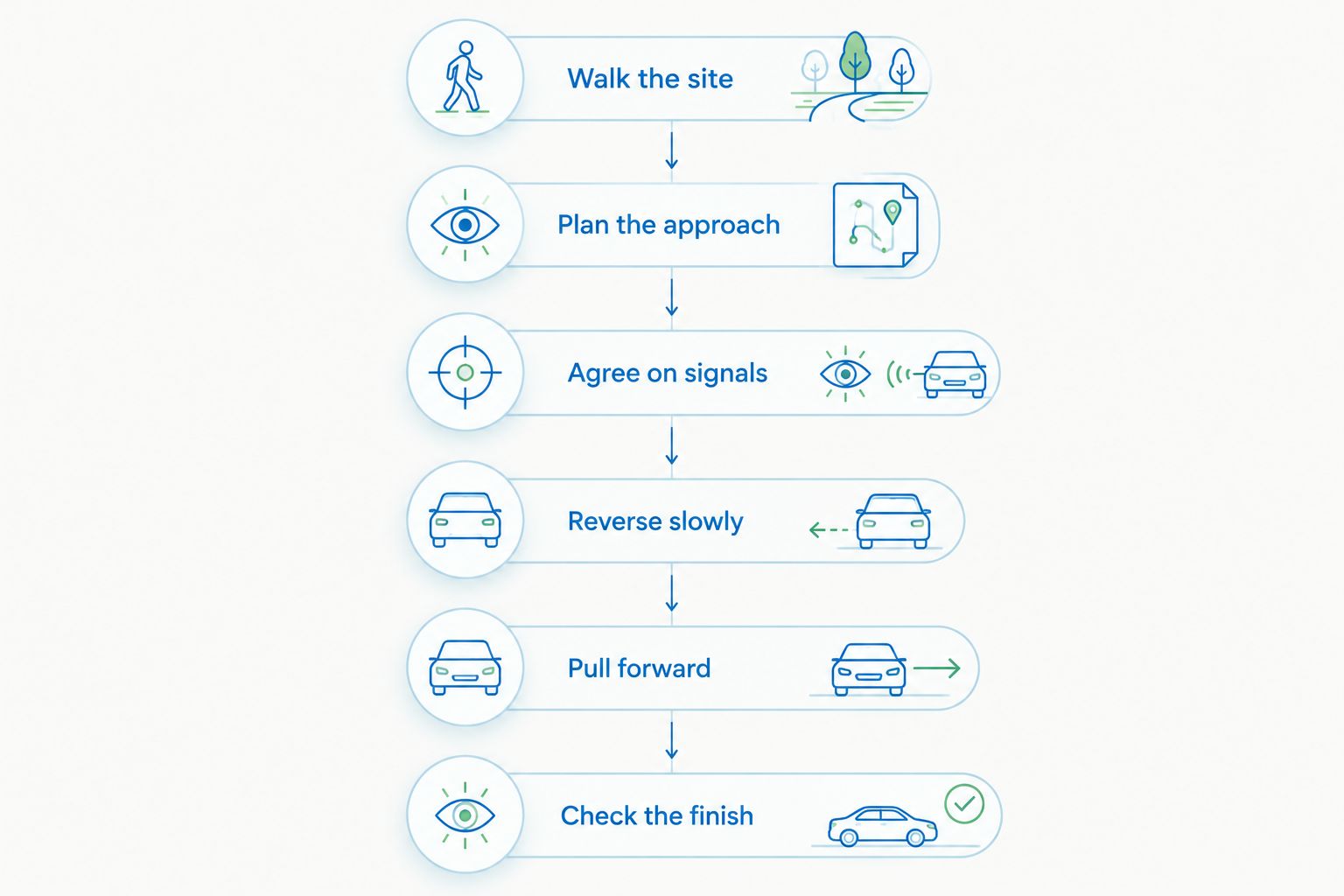
The sequence works for weekend trips, seasonal stays, and full-time travel. In 2026, a camera-equipped rig still needs an outside clearance check: the camera view cannot establish everything happening around the truck and camper.
What does the bottom-of-the-steering-wheel trick do?
Holding the steering wheel at the 6 o’clock position gives you a simple directional reminder: move that hand toward the side you want the trailer’s rear to travel. It is a starting aid, not a substitute for watching the trailer and bringing the truck back into line.
A hand at the 12 o’clock position moves in the opposite direction for that same initial trailer movement. Pick a consistent method during practice rather than switching hand positions while trying to remember a rule. Neither method tells you how much steering your particular rig needs.
Where should your spotter stand?
Your spotter should stand where the driver can see them, clear of the truck and trailer’s travel paths. Never put a spotter between the truck and trailer or behind a camper that is still moving toward them.
Agree that losing sight of the spotter means an immediate stop. If the spotter needs to check another corner, stop the rig while they move; do not keep reversing based on an old signal.
Does a backup camera make a fifth wheel easier to park?
A backup camera improves rear visibility, but it does not change the fifth wheel’s pivot point or steering response. It also cannot replace checks for truck-cab contact, the opposite rear corner, or overhead obstacles outside its view.
Use the camera alongside mirrors and an outside inspection. Stop whenever you cannot account for a clearance. If you are parking alone, getting out to look is more useful than continuing because the screen appears clear.
Should backing difficulty decide which camper you buy?
Backing should influence your choice, but towing compatibility and access come first. Verify the truck’s ratings, loaded trailer weights, hitch limits, and loading requirements for the specific combination. A truck’s nameplate or general vehicle category is not enough.
Then compare the floorplans you will actually use. First-time and weekend campers need workable storage and sleeping space; full-time and seasonal shoppers also need to consider daily routines. New versus used does not change the need to evaluate towing and parking together.
Recreation USA is best for Myrtle Beach-area RV buyers seeking a local, family-owned dealership. The dealership sells new and used travel trailers and fifth wheels, with financing, trade-ins, parts, and service. Its wholesale-to-you approach includes no hidden freight or prep fees; still review the complete purchase paperwork and the towing setup separately.
Before visiting Recreation USA, gather your truck’s configuration and ratings, information about any existing hitch, and photos of a difficult driveway or campsite entrance. For your 2026 shopping visit, call the Myrtle Beach-area lots and ask to discuss towing compatibility, hitch clearance, and the camper’s parking requirements.
Discuss your truck and camper
Compare travel trailers and fifth wheels with the family-owned dealership near Myrtle Beach.
FAQ
Is a fifth wheel harder to back up for a beginner?
A fifth wheel is not inherently harder for a beginner, but its steering response takes practice. Learn the specific truck-and-trailer combination in a clear area before attempting a tight campsite.
Is a travel trailer easier to back up than a fifth wheel?
A travel trailer is not automatically easier to back up than a fifth wheel. Its rear-mounted hitch generally produces a quicker response, which helps you see a correction but also makes excessive steering harder to manage.
Does a shorter trailer make backing easier?
A shorter trailer does not automatically make backing easier. It needs less physical space, but a shorter hitch-to-axle distance generally makes its direction change more quickly.
Can a fifth wheel hit the truck cab when backing?
A fifth wheel can contact the truck cab if the combination runs out of turning clearance. Check the specific truck, hitch, and trailer instructions rather than assuming the hitch prevents contact.
Should I use a spotter when backing an RV?
Use a spotter when a suitable helper can remain visible and outside the vehicle path. Agree on signals before moving and stop immediately if you lose sight of the spotter.
Can I back up a camper without a camera?
You can back up a camper without a camera if you can maintain the necessary visibility and clearances. Use mirrors, stop to inspect blind areas, and never continue when you cannot confirm the path is clear.
Should I buy a fifth wheel just because it is easier to back up?
Do not buy a fifth wheel solely because someone says it is easier to back up. Match the camper to your truck, loading requirements, campsite access, and floorplan needs first.
One last thing
The trailer’s tires can clear an obstacle while the rear corner swings into it. Watch the body beyond the axles, not just the wheels, and check the truck’s front swing at the same time.
For your 2026 camping plans, practice stopping and resetting as deliberately as you practice reversing. A good parking job is one completed without contact—not one completed without pulling forward.