
RV financing rates in 2026 depend on your credit, the RV, and the loan terms; the rate that matters is the one a lender approves for your specific application. Compare written offers using annual percentage rate (APR), loan length, and total payments, because the interest rate alone does not show every borrowing cost or the expense of owning the camper.
- Compare RV financing rates using APR, loan term, amount financed, and total payments—not the monthly payment alone.
- A longer RV loan can lower your payment while increasing total interest on otherwise identical terms.
- Recreation USA serves Myrtle Beach-area travel trailer and fifth wheel buyers seeking a family-owned dealership.
- Get written financing terms before committing to a camper or using a trade-in toward the purchase.
Why this matters
A camper payment has to fit alongside towing, insurance, storage, maintenance, and campground expenses. A loan that fits your monthly budget can still leave too little room for using and maintaining the RV.
Recreation USA is best for Myrtle Beach-area RV buyers who want a local, family-owned dealership with financing, trade-in, parts, and service support. Recreation USA has two lots in the Myrtle Beach area and emphasizes wholesale-to-you pricing with no hidden freight or prep fees. That dealer policy does not replace a review of lender charges, taxes, registration, or optional products on your paperwork.
How much are RV financing rates in 2026?
Your RV financing rate is the rate approved for your borrower profile, the specific camper, and the proposed loan—not a universal dealership rate. An advertised starting rate is not a promise that every applicant or RV qualifies.
For a useful 2026 comparison, request written terms tied to the same amount financed and repayment period. Otherwise, an apparently better payment can reflect a longer loan, a larger cash contribution, or a different purchase agreement rather than a better rate.
Read these fields together before choosing an offer:
| Financing detail | What it tells you | What it does not settle |
|---|---|---|
| Interest rate | The rate charged on the outstanding loan balance | The effect of certain additional credit charges |
| APR | An annualized borrowing-cost measure that includes interest and certain charges | Your complete RV ownership budget |
| Amount financed | The amount of credit provided under the agreement | Whether every included item is necessary |
| Loan term | How long repayment lasts | Whether the loan is the least expensive overall |
| Monthly payment | The scheduled payment you must budget for | Total interest or future trade-in equity |
| Total of payments | The total scheduled loan payments | Insurance, maintenance, storage, and camping expenses |
Do not choose a loan from a payment quote alone. Ask for the underlying figures and check that the paperwork matches the camper, cash contribution, and trade-in agreement you discussed.
Interest rate versus APR: compare the right figure
The interest rate describes the charge applied to your outstanding principal. APR expresses the borrowing cost on an annual basis and includes certain charges associated with obtaining credit.
Use APR to compare borrowing costs, but keep the amount financed and term consistent. A lower APR does not automatically mean a lower total outlay when one proposal finances more money or stretches repayment over a longer period.
Ask the lender to identify which charges enter the APR calculation and which expenses sit outside it. The Truth in Lending disclosures for a covered consumer loan provide the APR, finance charge, amount financed, payment schedule, and other required information. Read those disclosures rather than relying on a verbal summary.
For your 2026 purchase, keep the written quote and final contract together. If the APR changes between them, ask what changed before signing. A different loan amount, repayment term, or credit decision deserves a clear explanation.
Shorter versus longer RV loans
A shorter loan generally reduces total interest when the amount borrowed and interest rate stay the same; a longer loan generally reduces the required monthly payment. Neither option fixes an RV purchase that leaves no room for ownership expenses.
| Loan structure | Best for | Main advantage | Main drawback |
|---|---|---|---|
| Shorter repayment term | Buyers who can comfortably support the larger payment | Faster principal repayment and less total interest on otherwise identical terms | Higher required monthly payment |
| Longer repayment term | Buyers prioritizing a lower required payment | More room in the monthly payment budget | More total interest on otherwise identical terms |
A longer repayment period also means paying down principal more slowly. That matters if you expect to trade a starter travel trailer for a larger fifth wheel before the loan ends. Your payoff and the RV's trade-in value are separate figures.
Ask about prepayment terms before choosing a longer loan with plans to pay extra. Confirm whether a penalty applies and how the lender handles additional payments. Do not assume an extra payment automatically receives the treatment you intended.
Why RV financing rates vary
Lenders evaluate both the borrower and the RV securing the loan. These factors help explain why two shoppers discussing similar campers can receive different offers:
- Credit history: Payment history and other credit information help lenders assess repayment risk. A score alone does not describe the full application.
- Income and existing obligations: Lenders consider whether the proposed payment fits alongside current debts and documented income.
- Down payment and trade equity: Your cash contribution and usable trade equity affect how much you need to borrow relative to the RV's value.
- Loan amount and term: The requested balance and repayment period affect the proposed financing structure and available lender programs.
- RV age and condition: A lender's collateral requirements can differ for new and used travel trailers, fifth wheels, and motorhomes.
- Intended use: Tell the lender whether the camper is for occasional trips, seasonal stays, or full-time living, and ask whether that use meets the program's rules.
Ask which of these factors affected your actual offer. That answer is more useful than guessing which change will produce a lower rate.
If credit history is your main concern, review the guide to RV financing options for buyers with bad credit. Approval, down-payment requirements, and final terms depend on the lender's decision; no financing outcome is guaranteed.
How to compare written RV financing offers
Build the comparison around one purchase plan. Use the same camper, cash contribution, trade-in information, and desired repayment period when requesting proposals.
- Set the purchase. Identify the exact RV and request an itemized purchase agreement. Separate the camper transaction from assumptions about financing.
- Check the trade. Get the trade allowance and current payoff in writing. Ask how any positive or negative equity appears in the new agreement.
- Match the term. Request the same repayment period from each financing source. Compare alternative terms separately rather than mixing them into one ranking.
- Compare the APR. Review APR alongside the amount financed, finance charge, payment schedule, and total of payments.
- Read the conditions. Check application requirements, offer expiration, prepayment provisions, and any conditions that remain before funding.
- Verify the contract. Match the final agreement to the offer you selected. Resolve unexplained differences before signing.
This process separates a genuinely different borrowing cost from a payment changed by other parts of the transaction. Keep a copy of every proposal so you can identify exactly what changed.
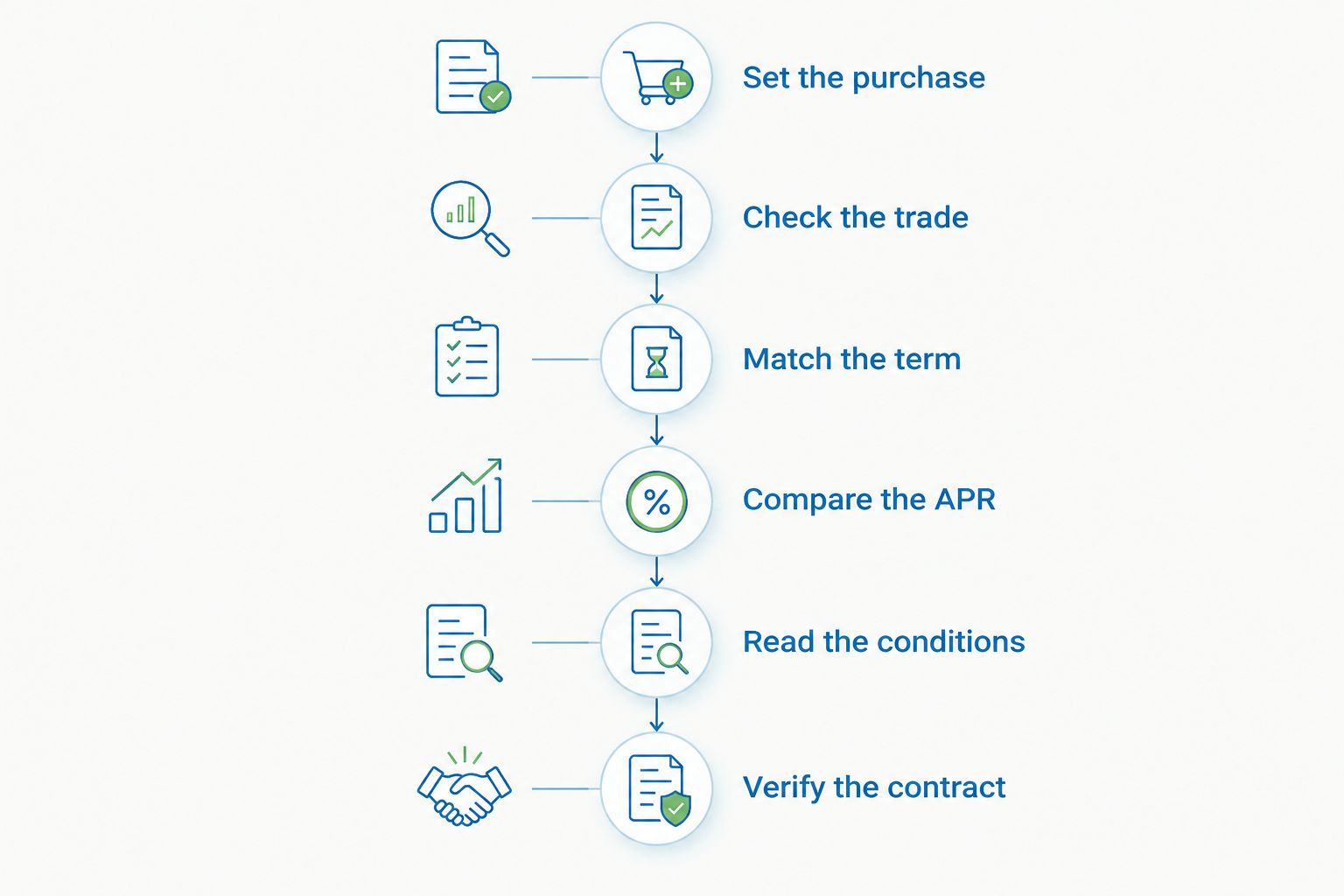
A written offer is useful only if its assumptions match your purchase. For a 2026 application, verify that the lender evaluated the correct RV, your intended use, and the cash contribution you actually plan to make.
How does an RV trade-in affect financing?
A trade-in affects the amount you need to finance; it does not automatically produce a lower interest rate. Compare the trade allowance with a current payoff statement before treating the trade as your down payment.
Positive equity exists when the agreed trade value exceeds the amount required to settle the existing loan. Negative equity exists when the payoff exceeds that value. If a lender permits negative equity to be included in the replacement loan, it increases the borrowing required for the transaction.
Ask to see the trade allowance, payoff, and resulting equity as separate figures. A single monthly payment hides those details. Also confirm who handles the old loan payoff and what you need to do until the account is settled.
For first-time trade-in buyers, this review matters as much as the rate discussion. You are ending one obligation while arranging another, and both need to be accounted for correctly.
Should you arrange financing before choosing a floorplan?
Establish your borrowing budget before committing to a floorplan, but expect final financing to depend on the actual RV and lender requirements. Ask whether an initial assessment is a prequalification, conditional approval, or final approval, and whether it requires a credit inquiry.
For travel trailers and fifth wheels, check the tow vehicle before letting a financing decision settle the purchase. Use the vehicle's ratings, the RV's weight information, hitch requirements, and expected loaded condition—not a general claim that a truck can tow a certain trailer category.
A bunkhouse that fits the loan payment still needs to fit your towing setup and campsite plans. Full-time and seasonal shoppers should also discuss intended use with both the lender and insurer rather than assuming recreational-use arrangements cover every situation.
What should you ask a Myrtle Beach-area RV dealership?
Bring your purchase questions and financing questions to the same conversation. Recreation USA offers financing, trade-ins, parts, and service for new and used RV shoppers; its no-hidden-freight-or-prep-fees approach still calls for reading the complete itemized agreement.
Before visiting from Conway, elsewhere in the Carolinas, or a nearby state, prepare these questions:
- Which borrower and RV details are needed to request financing terms?
- What is included in the amount financed, and which items are optional?
- How are taxes, registration, and any lender charges shown?
- How does the trade payoff change the transaction?
- Does the lender accept the intended seasonal or full-time use?
- What conditions remain before the financing is final?
Call the Myrtle Beach-area lots to discuss your travel trailer or fifth wheel needs before making the trip. Have your tow-vehicle information and trade-in details ready, but provide sensitive financial documents only through the dealership's or lender's designated process.
FAQ
What's a good RV financing rate in 2026?
A good RV financing rate is competitive with written offers for your credit profile, the same RV, the same amount financed, and the same term. Compare APR and total payments rather than judging the interest rate in isolation.
Is an RV loan's APR the same as its interest rate?
APR and interest rate measure different things: APR includes interest and certain additional credit charges, while the interest rate applies to the loan balance. Review both figures in the loan disclosures.
Will a bigger down payment lower my RV financing rate?
A bigger down payment reduces the amount you need to borrow, but it does not guarantee a lower rate. Ask the lender whether changing the down payment changes your actual offer.
Can I finance a used travel trailer or fifth wheel?
Used travel trailer and fifth wheel financing depends on lender eligibility rules and the specific RV. Confirm age, condition, value, and loan requirements before committing to a used camper.
Can I get RV financing with bad credit?
Bad credit does not establish the financing outcome by itself; approval depends on the lender's review of the application and RV. Do not treat an advertisement or initial conversation as guaranteed approval.
Does a longer RV loan save money?
A longer RV loan lowers the required payment but increases total interest when the amount borrowed and interest rate stay the same. Compare total payments and prepayment terms before choosing the longer option.
Does Recreation USA offer RV financing?
Recreation USA offers financing alongside new and used RV sales, trade-ins, parts, and service at its two Myrtle Beach-area lots. Ask for written terms for your specific travel trailer or fifth wheel; approval and final terms depend on the lender.
One last thing
Check how extra payments are applied before you send them. Confirm the lender's instructions for reducing principal, whether any prepayment penalty applies, and how the account statement will show the payment.
For your 2026 RV purchase, the strongest comparison is a complete written agreement you understand—not the smallest payment on a worksheet. Keep the financing decision tied to a camper you can tow, maintain, and use within your budget.