Instead of repeating uncertain checks every time you hitch up, use this sequence for how to hook up a fifth wheel hitch: confirm truck compatibility, seat and lock the kingpin, connect the brakes, and verify the connection before retracting the landing gear. This 2026 guide covers coupling an installed hitch to a fifth wheel—not installing a hitch in your truck bed.
- Recreation USA serves fifth wheel buyers around Myrtle Beach who want a local, family-owned dealership.
- Knowing how to hook up a fifth wheel hitch starts with truck ratings and the hitch manufacturer's instructions.
- Inspect the jaws and kingpin directly; a closed handle alone does not prove a secure connection.
- Complete the prescribed pull test with wheel chocks and landing-gear protection before preparing for travel.
Why this matters
A one-ton badge does not establish whether your truck can carry a particular fifth wheel. Loaded pin weight, passengers, hitch equipment, and truck-bed cargo all count against the truck's available payload; axle, tire, towing, and combined-weight limits also apply.
Recreation USA is best for fifth wheel shoppers around Myrtle Beach who want a local, family-owned dealership. Recreation USA offers new and used RVs, financing, trade-ins, parts, and service, with wholesale-to-you pricing and no hidden freight or prep fees. Financing is not a substitute for confirming that the truck and trailer fit each other.
For your 2026 camping plans, make a secure connection the first requirement—not something you judge by whether the trailer follows the truck. A kingpin can appear connected without sitting correctly inside the locking mechanism.
Before you start
- Gather the right documents and equipment. Have the truck's towing information, its actual payload label, and the manuals for the hitch, trailer, brake controller, and landing gear. Bring suitable wheel chocks and a flashlight; use firm, reasonably level ground.
- Confirm the complete towing combination. Check loaded trailer weight and pin weight against every applicable rating, including the hitch and mounting system. The guide to fifth wheels for three-quarter-ton and one-ton trucks provides related shopping context, but your specific truck's ratings control the decision.
- Prevent high hitching. Set the trailer's coupling plate height exactly as the hitch manual requires. A plate that sits too high can let the kingpin engage incorrectly; a handle that looks closed does not correct that condition.
If the hitch is not already installed, stop here. Mounting rails, factory puck adapters, fasteners, and torque requirements are installation-specific. Have the installation completed and checked according to the truck and hitch manufacturers' instructions before coupling a trailer.
Choose the correct hitch configuration
The connection procedure must match the equipment in your truck. These are hitch configurations, not interchangeable instructions or recommendations for a particular product.
| Configuration | Best for | Advantage | Limitation |
|---|---|---|---|
| Fixed hitch | Combinations with verified cab-to-trailer clearance | No sliding position to manage | Does not create additional turning clearance |
| Manual sliding hitch | Compatible combinations needing extra maneuvering clearance | Lets the driver change hitch position as instructed | Requires deliberate operation and lock verification |
| Automatic sliding hitch | Compatible combinations using an approved automatic sliding system | Changes position during turns according to its design | Can require specific capture hardware and coupling alignment |
Use only a configuration approved for your truck, trailer, and mounting system. A short bed does not automatically identify the correct hitch, and a long bed does not remove the need to check clearance.
Prepare the truck
- Secure the trailer. Apply wheel chocks that prevent movement in both directions. Keep the landing gear supporting the trailer, and follow the trailer manual's instructions for leveling equipment before coupling.
- Inspect the mounting system. Check the hitch's attachment points, retaining pins, and visible hardware using its prescribed inspection procedure. Do not couple if you find looseness, damage, missing retainers, or uncertain installation.
- Inspect the connection surfaces. Examine the kingpin, trailer coupling plate, hitch head, and locking mechanism. Remove obstructions and address damage before proceeding. Use only the lubrication or lube plate the hitch manufacturer specifies.
- Prepare the hitch mechanism. Place the jaws, handle, and any safety latch in the coupling position described in the manual. Some mechanisms require a different starting position from others; do not force a handle to imitate another hitch.
- Clear the truck bed. Remove items that can interfere with the hitch or trailer. Position the tailgate as required for backing underneath, and confirm clearance around bed rails and accessories.
Expected result: the trailer cannot roll, the hitch is securely mounted, and the locking mechanism is ready to receive the kingpin.
Use a spotter when visibility is limited. Agree on a stop signal before moving, keep the spotter visible, and stop immediately if you lose sight of them. Nobody belongs between the moving truck and trailer or inside a pinch point.
Align the kingpin
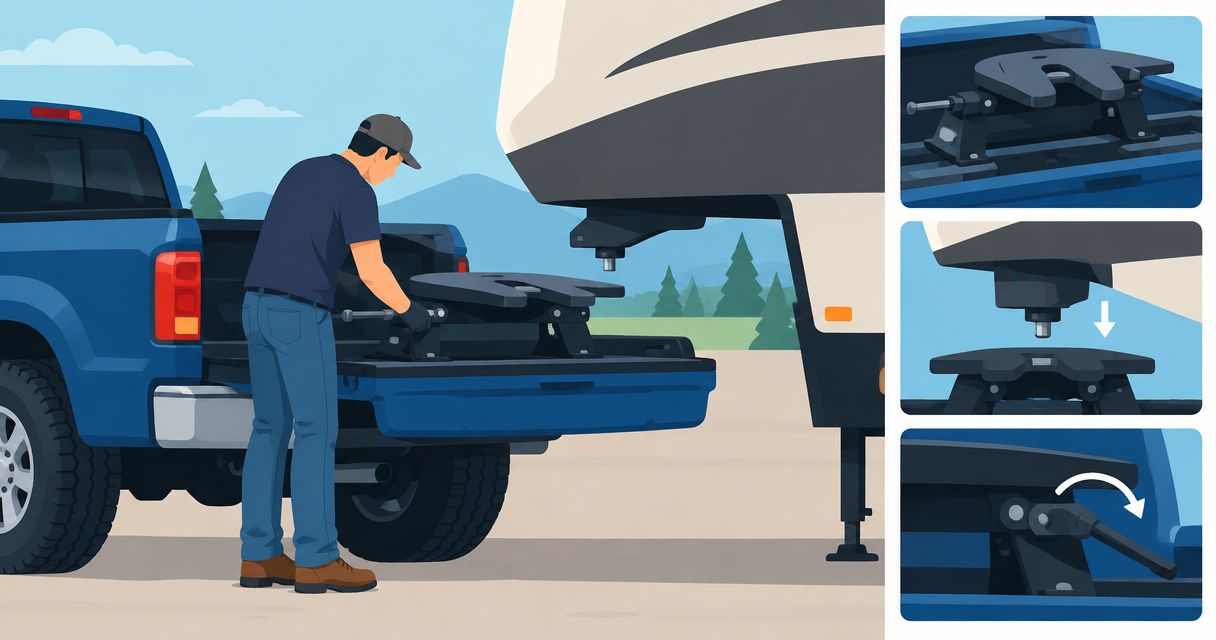
- Set coupling height. Adjust the landing gear until the trailer plate and hitch head have the relationship specified in the hitch manual. Do not use an arbitrary gap or measurement borrowed from another hitch.
- Line up the truck. Approach the kingpin along the alignment the hitch manufacturer requires. Automatic sliding systems can have specific alignment requirements; check those before backing.
- Back slowly into the hitch. Move at a controlled crawl until the kingpin enters and the mechanism engages. If something binds or the trailer moves unexpectedly, stop rather than applying more throttle.
- Secure the truck before inspecting. Set the parking brake and place the transmission in its parking position before leaving the cab. Do not reach into the hitch while the truck or trailer is moving.
Expected result: the trailer plate rests against the hitch head as designed, and the kingpin sits in the locking mechanism—not above it.
An audible click is not the inspection. Use a flashlight and the manufacturer's inspection points to see the kingpin's position and the jaws or locking bar. If the design prevents a clear view, use its specified verification procedure rather than guessing.
Verify the lock
- Inspect the actual engagement. Confirm the locking mechanism has captured the kingpin in the position shown in the manual. Check plate contact, jaw or bar position, and any indicator the manufacturer provides.
- Secure the safety retention. Engage the specified latch, retaining pin, clip, or other handle restraint. An indicator or closed handle does not replace this step.
- Connect the electrical plug. Seat the trailer's 7-pin connector fully in the truck socket and secure it as the socket design requires. Route the cable so it can accommodate turns without dragging or being pinched.
- Attach the breakaway cable. Use the designated truck attachment point specified for the system. Route the cable independently of the electrical cord, with enough movement for turns but without allowing it to snag or drag.
- Prepare for the prescribed pull test. Keep the trailer chocked and follow the hitch manual's instructions for landing-gear clearance and trailer-brake application. Keep the landing gear positioned to limit a drop if the connection fails, without dragging the feet.
- Perform the controlled pull test. Apply the trailer brakes as instructed and make the manufacturer's prescribed gentle forward check. Stop immediately if the kingpin releases, the trailer shifts unexpectedly, or the locking mechanism moves out of position.
Expected result: visual inspection, safety retention, and the prescribed pull test all confirm the connection. If any check fails, do not retract the landing gear for departure.
A pull test supports the inspection; it does not replace it. Do not improvise a hard acceleration test or depend on wheel chocks alone to prove the lock.
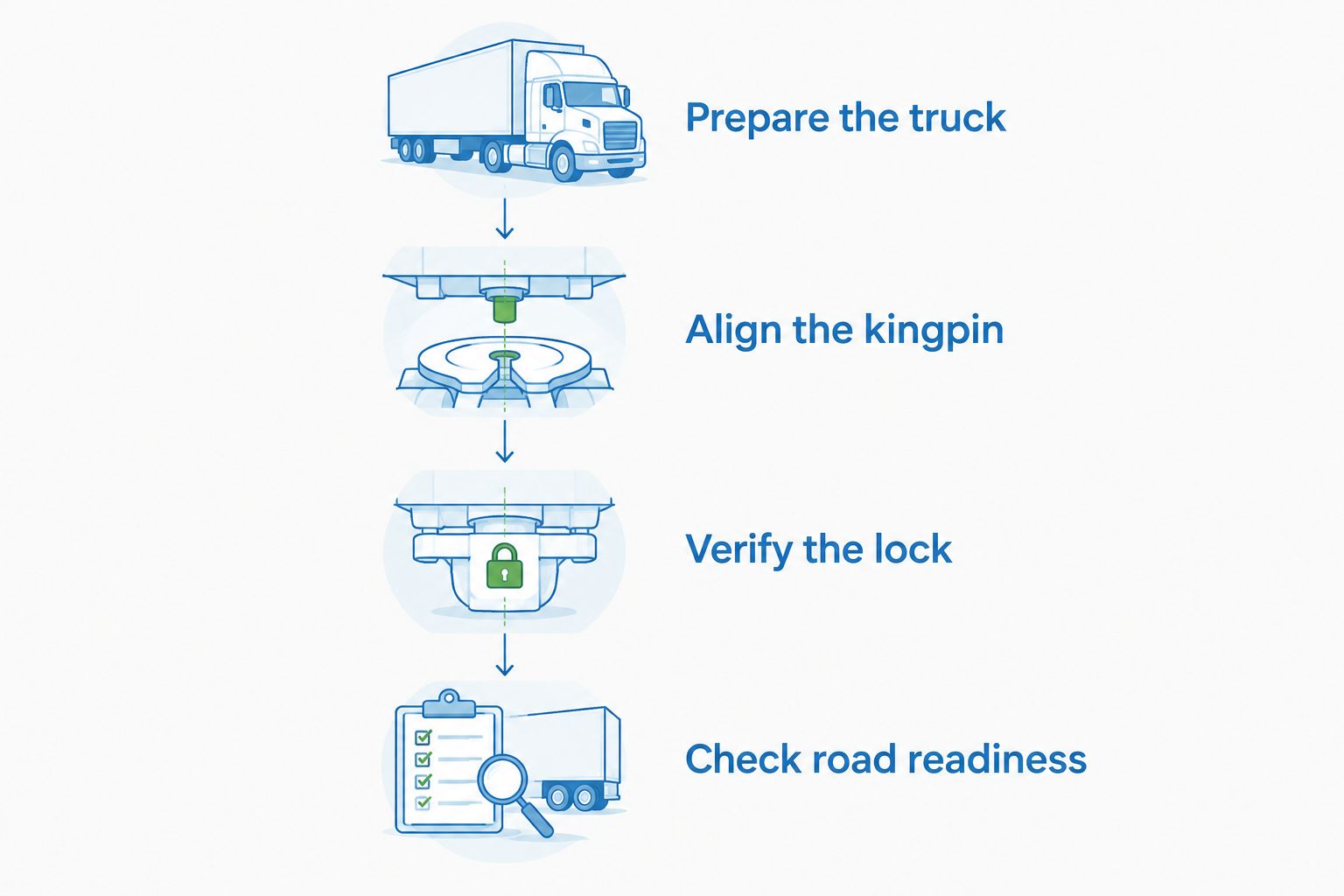
Check road readiness
- Finish the support-system sequence. After the connection passes its checks, retract landing gear and stabilizers according to the trailer manual. Confirm the feet and any separate supports are clear for travel.
- Restore the tailgate position. Close and latch the tailgate when your combination requires it. Check that the trailer, pin box, and cables will clear the tailgate and bed rails during movement.
- Check lights and brakes. Verify the trailer's brake lights, turn signals, and running lights. Test brake-controller operation and the breakaway system using their manuals; a working light does not prove that trailer brakes work.
- Check electrical power. For systems using a 12-volt battery, confirm the battery and breakaway circuit are ready according to the trailer's instructions. The truck connector alone is not a reason to skip this check.
- Complete a 360-degree walk-around. Inspect tires, access doors, steps, awnings, loose equipment, and travel locks. Account for every wheel chock before leaving.
- Make a controlled low-speed departure. In a clear area, confirm braking response and watch for interference. Adjust the brake controller according to its manual, not a setting remembered from a different trailer.
Expected result: the trailer supports are stowed, brakes and lights function, and nothing obstructs safe movement.
For a 2026 trip from Conway or Myrtle Beach, repeat this process after each disconnect. A successful connection yesterday does not verify today's locking mechanism, electrical plug, or breakaway cable.
Second workflow: disconnect at your campsite
Unhitching is a separate procedure. Support and secure the trailer before releasing the hitch, and follow the equipment manuals for the exact order.
- Park on suitable ground, set the truck's parking brake, and chock the trailer against movement in both directions.
- Follow the trailer manual's instructions for placing the landing gear and transferring support. Do not lift the truck or force the hitch apart.
- Disconnect and safely stow the electrical cord and breakaway cable as instructed. Clear the tailgate and check for obstacles.
- Release the hitch's safety retention and locking mechanism using its prescribed procedure. Relieve binding only as the manufacturer directs.
- Pull the truck clear slowly, checking that the kingpin, pin box, and tailgate do not interfere.
- Complete leveling and stabilizer deployment in the trailer manufacturer's sequence.
Expected result: the trailer stands securely on its supports with the wheels chocked, and the truck clears without pulling against the hitch.
Record coupling height if your equipment supports that feature. Ground slope and loading can change the relationship between truck and trailer, so still inspect alignment when reconnecting.
Troubleshooting
The handle will not close or lock
Stop and inspect alignment, plate height, and the mechanism's starting position. With the trailer secured and supported, reset the hitch according to its manual and try again. Never hammer the handle or use the truck's power to force engagement.
The handle looks closed, but the plates have a gap
Treat the connection as unverified. The kingpin can be incorrectly positioned despite the handle's appearance; support the trailer and uncouple according to the manual before resetting height and alignment. Do not tow until the specified plate contact and locking position are confirmed.
The trailer brakes do not respond
Check connector seating, the brake controller's trailer detection, its settings, and the relevant fuses and wiring. Stop the departure process until the braking fault is corrected. Working turn signals do not establish that the brake circuit works.
The hitch will not release
A loaded or misaligned connection can bind the mechanism. Secure the trailer, check support height, and use the manufacturer's load-relief procedure. Do not stand between truck and trailer, pry the jaws, or pull away against a locked hitch.
The trailer approaches the cab during a turn
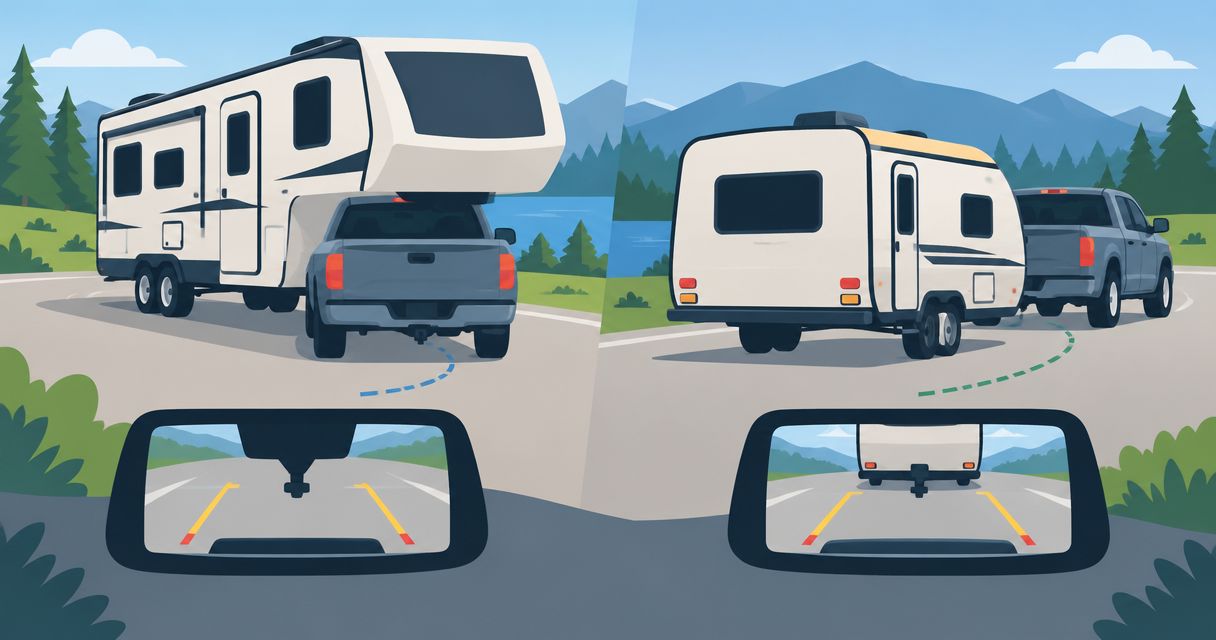
Stop before contact. Recheck the combination's clearance and the hitch's maneuvering instructions. A sliding hitch only helps when it is compatible, operated correctly, and locked in the required position; it does not make every turn safe.
Customize your workflow
Keep a checklist for your exact truck, hitch, and fifth wheel. Include the locking inspection, cable routing, controller check, support sequence, and the manufacturer's pull-test procedure. Keep it with the towing manuals rather than relying on memory.
For a new or used fifth wheel purchased in 2026, ask for a hands-on explanation using your actual equipment. Recreation USA offers parts and service alongside RV sales; call the Myrtle Beach-area lots to discuss your hitch questions and service needs before arranging a visit.
For first-time, trade-in, full-time, and seasonal shoppers, the same rule applies: confirm the towing combination before choosing the floorplan. Keep a local dealership conversation focused on your truck's documentation and the trailer's loaded use—not just the one-ton label.
Discuss your fifth wheel setup
Ask about fifth wheel shopping, parts, and service at the Myrtle Beach-area lots.
FAQ
How do I hook up a fifth wheel hitch safely?
Secure the trailer, prepare the hitch, align the kingpin, and verify the locking mechanism before preparing for travel. Connect the electrical and breakaway systems, perform the manufacturer's prescribed pull test, and check brakes, lights, and support retraction.
Can any one-ton truck tow a fifth wheel?
No, a one-ton designation does not establish compatibility with every fifth wheel. Check the specific truck's payload, axle, tire, towing, and combined-weight ratings against the loaded trailer and all equipment and passengers.
How high should the fifth wheel be when I back under it?
Set the trailer coupling plate to the height relationship specified in your hitch manual. An incorrect height can prevent proper kingpin engagement, so do not substitute a universal measurement.
Does a closed hitch handle mean the fifth wheel is locked?
No, a closed handle alone does not prove correct kingpin engagement. Inspect the actual locking mechanism and plate position, secure the safety retention, and complete the prescribed pull test.
Should I remove the wheel chocks before testing the hitch?
Keep the trailer chocked for the coupling and pull-test procedure, following the hitch manufacturer's instructions. Remove and stow the chocks only after the connection and departure checks are complete.
Do I need a sliding hitch with a short-bed truck?
The answer depends on verified cab-to-trailer clearance and equipment compatibility, not bed length alone. Check the truck, trailer, pin box, and hitch requirements before selecting or operating a sliding system.
Where should I attach the fifth wheel breakaway cable?
Attach the breakaway cable to the designated truck anchor specified for your system. Route it separately from the electrical cord and prevent dragging, snagging, or tension during normal turns.
Can Recreation USA help with fifth wheel ownership questions in 2026?
Recreation USA sells new and used fifth wheels and offers parts and service in the Myrtle Beach area. Call the lots to discuss your truck, hitch, trailer, and the assistance you need before visiting.
One last thing
After any interruption, repeat the connection inspection before moving. A conversation, an equipment adjustment, or someone helping with the hitch can interrupt the sequence without leaving an obvious sign. On your 2026 departure checklist, make the final walk-around the last action before you get in the truck.