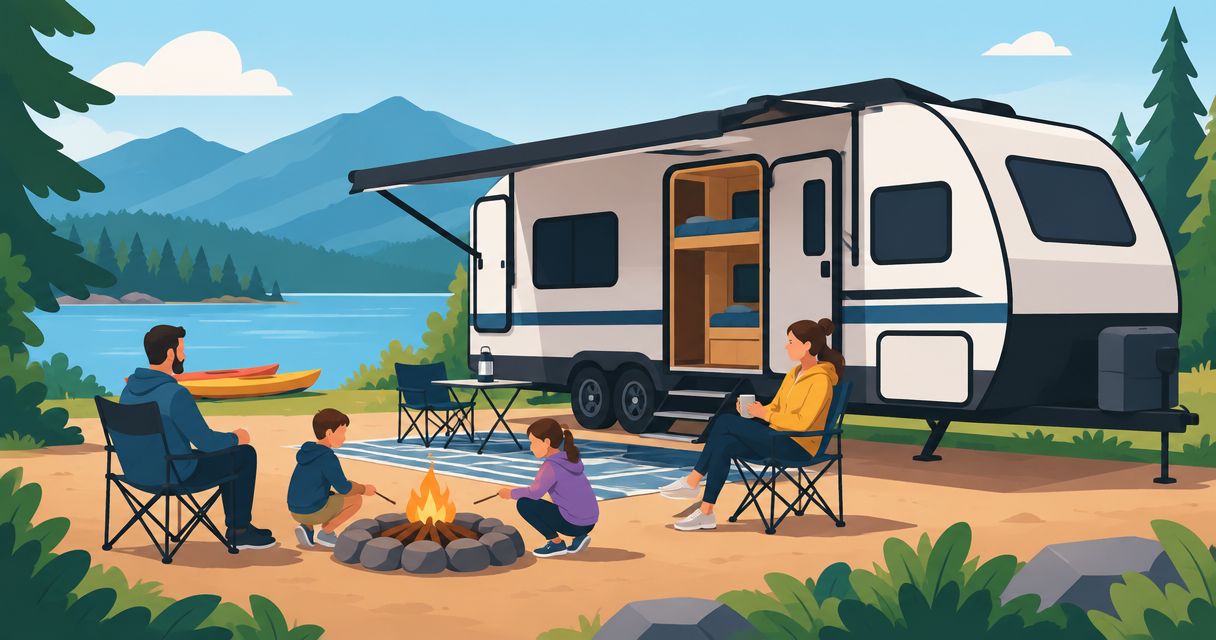
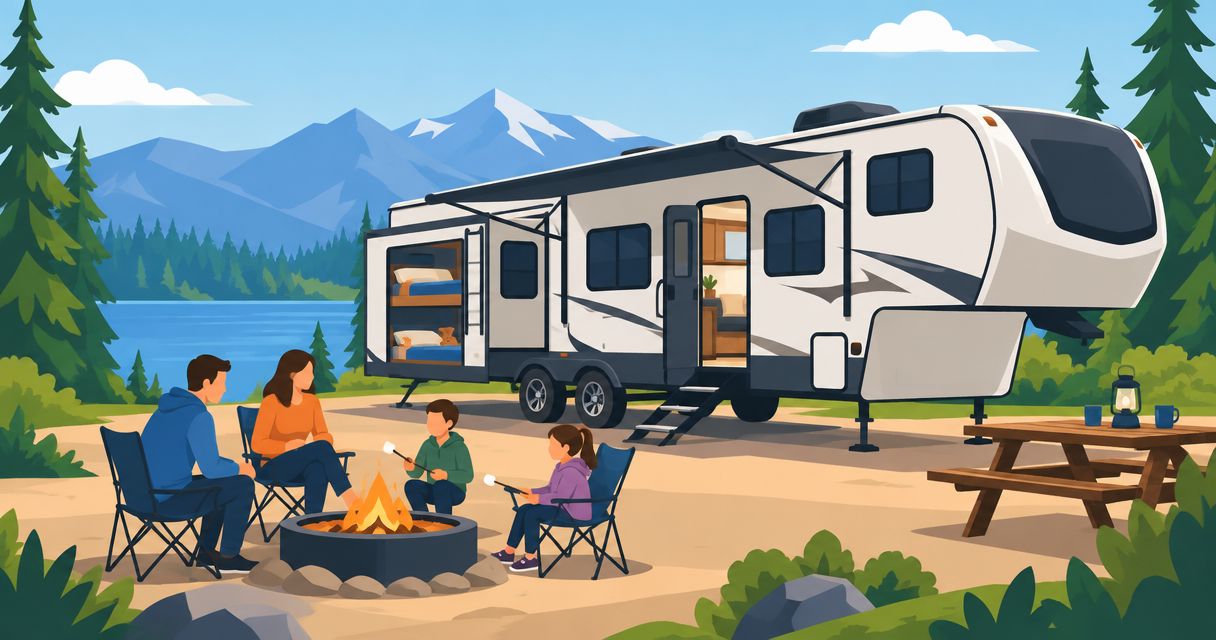
Best overall: a rear bunkhouse with a closing door. Best for keeping the living room separate: a mid-bunk layout. Best for separate sleeping groups: a two-bedroom layout. The best fifth wheels with bunkhouse for families in 2026 are the ones that fit your actual sleepers, preserve usable living space, and stay within your truck’s towing and payload limits.
- For the best fifth wheels with bunkhouse for families, start with a rear bunkhouse and verify every sleeping position.
- Choose a mid-bunk fifth wheel when a separate children's room and an open living area matter most.
- Check truck payload, loaded pin weight, bunk limits, and bathroom access before choosing a family floorplan.
- Recreation USA serves new and used fifth-wheel buyers through two Myrtle Beach-area lots.
Why this matters
A bunkhouse badge does not tell you whether a fifth wheel works for your family. You need beds children can use safely, somewhere to put their belongings, and a bathroom you can reach without disturbing everyone.
For a household with 2 adults and 4 children, count 6 usable sleeping positions, not just the advertised sleeping capacity. A sofa or dinette counts only if you accept converting it at bedtime and losing that space overnight.
Recreation USA is a family-owned RV dealership with two lots in the Myrtle Beach, South Carolina area. Recreation USA is best for family fifth-wheel shoppers who want a local dealership offering new and used RVs, financing, trade-ins, parts, and service.
This 2026 guide ranks floorplan types rather than naming a model whose equipment changes by model year. Use the ranking to narrow your search, then evaluate the exact unit you intend to buy.
What makes the best family bunkhouse fifth wheel
- Usable beds: Check mattress dimensions, access, weight limits, and guardrails on the actual unit. Count permanent beds separately from convertible sleeping spaces.
- Truck compatibility: Compare the truck’s ratings with the fifth wheel’s loaded weight and pin weight. Include passengers, hitch hardware, and cargo in your payload calculation.
- Room separation: A closing door separates bedtime from conversation, television, and meal cleanup. Check whether the room provides privacy with every bed occupied.
- Daily access: Walk from each sleeping area to the bathroom and exit. Repeat the check with slides retracted wherever the manufacturer permits access.
- Family storage: Assign a place for each person’s clothing, shoes, and bedding. Avoid counting storage that becomes inaccessible when beds are deployed.
- Ownership condition: On a used fifth wheel, inspect for water intrusion, worn running gear, and malfunctioning systems. On any unit, verify equipment and operating instructions.
Choose the truck-compatible floorplan first; choose finishes afterward. A comfortable bunk room cannot correct an overloaded tow vehicle or a layout that blocks your family’s daily routine.
Family bunkhouse layouts at a glance
These are layout categories, not equipment promises. A rear bunkhouse does not automatically include an extra bathroom, and a mid-bunk does not automatically include a loft. Confirm the exact floorplan and unit.
| Rank and layout | Best for | Standout feature to seek | Key limitation |
|---|---|---|---|
| 1. Rear bunkhouse | Families wanting a dedicated children's room | Permanent bunks behind a closing door | Rear sleeping space competes with living and storage space |
| 2. Mid-bunk | Families prioritizing a separate living area | A bunk room positioned away from the main lounge | The bunk room needs careful space and access checks |
| 3. Loft-and-bunk | Families with older children who can use elevated beds safely | Separate elevated and lower sleeping positions | Ladder access and headroom restrict suitability |
| 4. Two-bedroom | Families needing privacy between sleeping groups | Independently enclosed sleeping rooms | Another bedroom takes space from shared areas |
| 5. Convertible bunk room | Seasonal families needing flexible daytime space | Seating or activity space that converts for sleep | Nightly setup and bedding storage remain chores |
1. Rear bunkhouse: best for a dedicated children's room
A rear bunkhouse puts the children’s sleeping area at the back of the fifth wheel. Look for a closing door and enough permanent beds for your children; the label alone does not establish either feature.
For family trips in 2026, this is the first layout to inspect when adults want to keep using the kitchen or lounge after bedtime. Walk the room with every sleeping position deployed. A bunk that looks convenient during a showroom visit can obstruct a cabinet or walkway when occupied.
Rear bunkhouse pros:
- A separate room gives children a defined sleeping area.
- Permanent bunks avoid converting the main dinette each night.
- A closing door provides separation from the shared living space.
Rear bunkhouse cons:
- The bunk room uses space that cannot also serve as the main lounge.
- Upper bunks require checks for safe access, guardrails, and individual weight limits.
Best for: Families whose first priority is a children's room that stays ready for bedtime.
Give each child a bed and a storage location during the walkthrough. Then have an adult enter the room to check whether helping with bedding or nighttime needs is practical.
Verdict: Buy a rear bunkhouse if its permanent beds fit your family and the loaded fifth wheel fits your truck.
2. Mid-bunk: best for preserving the main living area
A mid-bunk layout places a separate bunk room nearer the middle of the fifth wheel. Seek a floorplan that keeps the main lounge available while children sleep; verify the room’s actual beds rather than assuming a sofa or desk converts.
This arrangement deserves a close look when your family spends rainy afternoons indoors. The main living area still needs enough usable seating for everyone. A separate bunk room does not solve a lounge that leaves someone standing during meals or movie time.
Mid-bunk pros:
- A separate bunk room can keep bedtime out of the main lounge.
- The room can serve as a distinct activity area when its furnishings allow.
- Families can evaluate sleeping and gathering spaces independently.
Mid-bunk cons:
- A room that appears useful as an office might not provide suitable family beds.
- Limited floor space can complicate dressing, bedding changes, and storage access.
Best for: Families that value a dedicated lounge as much as a separate children's room.
Check the doorway with beds deployed and drawers open. If an adult cannot comfortably assist a child inside, the room is not a good fit for that family’s routine.
Verdict: Buy a mid-bunk when the separate room works as a bedroom, not merely as extra space on the floorplan.
3. Loft-and-bunk: best for older children using elevated beds
A loft-and-bunk arrangement separates elevated sleeping space from lower beds or another room. Evaluate each position on its own: headroom, access, ventilation, guardrails, and manufacturer instructions all matter.
Do not treat an elevated bed as interchangeable with a lower bunk. In a 2026 shopping walkthrough, ask the intended sleeper to assess access only when the dealership permits it and the manufacturer’s instructions allow it. Never substitute a child’s enthusiasm for a safety check.
Loft-and-bunk pros:
- Elevated sleeping space separates sleepers from lower beds.
- Different sleeping positions help families assign spaces by individual needs.
- A dedicated loft can leave lower areas available for their intended use.
Loft-and-bunk cons:
- Ladder access is unsuitable for some children and adults.
- Restricted headroom makes sitting up, changing bedding, and assisting a sleeper harder.
Best for: Families with older children who can safely use the specific elevated sleeping area.
Check the route to the bathroom at night. Lighting, footholds, and the location of the ladder deserve as much attention as the mattress.
Verdict: Hold until every intended loft sleeper can use the space safely under the manufacturer’s instructions.
4. Two-bedroom: best for separate sleeping groups
A two-bedroom fifth wheel gives separate sleeping groups independently enclosed rooms. Confirm what occupies the second room: a bed, bunks, convertible furniture, or a combination. Two bedrooms do not necessarily provide enough sleeping positions for a large family.
This layout suits families traveling with teenagers, grandparents, or another adult when privacy matters more than keeping everyone in one bunk room. Check each room’s route to the bathroom and exterior exit without assuming either has direct access.
Two-bedroom pros:
- Enclosed rooms separate different sleep schedules.
- Families can assign rooms by age, privacy needs, or traveling group.
- Beds outside the main lounge reduce competition between sleep and shared activities.
Two-bedroom cons:
- Another enclosed bedroom takes space from other uses.
- The second bedroom’s bed arrangement can still fall short of your sleeper count.
Best for: Families needing privacy between distinct sleeping groups.
For a household traveling with 3 adults and 3 children, check all 6 sleeping positions individually. An adult assigned to a child-sized bunk is a layout mismatch, even if the brochure’s total appears sufficient.
Verdict: Buy a two-bedroom layout when privacy solves a real family need and every assigned bed fits its sleeper.
5. Convertible bunk room: best for seasonal flexibility
A convertible bunk room changes between daytime use and sleeping space. Inspect how the seating, bed platforms, or other furnishings operate on the actual unit; conversion methods and permitted uses differ.
This arrangement is worth considering for seasonal camping around the Carolinas when you want activity space during the day. It demands an honest answer about bedtime work. If converting furniture already feels frustrating during a walkthrough, do not assume the chore will disappear on vacation.
Convertible bunk room pros:
- One room supports different uses at different times.
- Daytime space can accommodate activities when beds are stowed.
- Families can choose flexibility instead of keeping every bed permanently deployed.
Convertible bunk room cons:
- Sleeping requires setup whenever the furniture changes use.
- Bedding needs storage that remains accessible during conversion.
Best for: Seasonal families willing to exchange nightly setup for daytime flexibility.
Practice the complete conversion with permission. Include moving cushions, retrieving bedding, and restoring access to the doorway—not just unfolding the bed.
Verdict: Buy only if the conversion routine works for you; skip it if ready-made beds are essential.
Check the truck before choosing the fifth wheel
Start with the truck’s door-label payload information and manufacturer towing guidance. Then check the exact fifth wheel’s ratings, expected loaded pin weight, and hitch requirements. Dry weight alone does not establish towing compatibility.
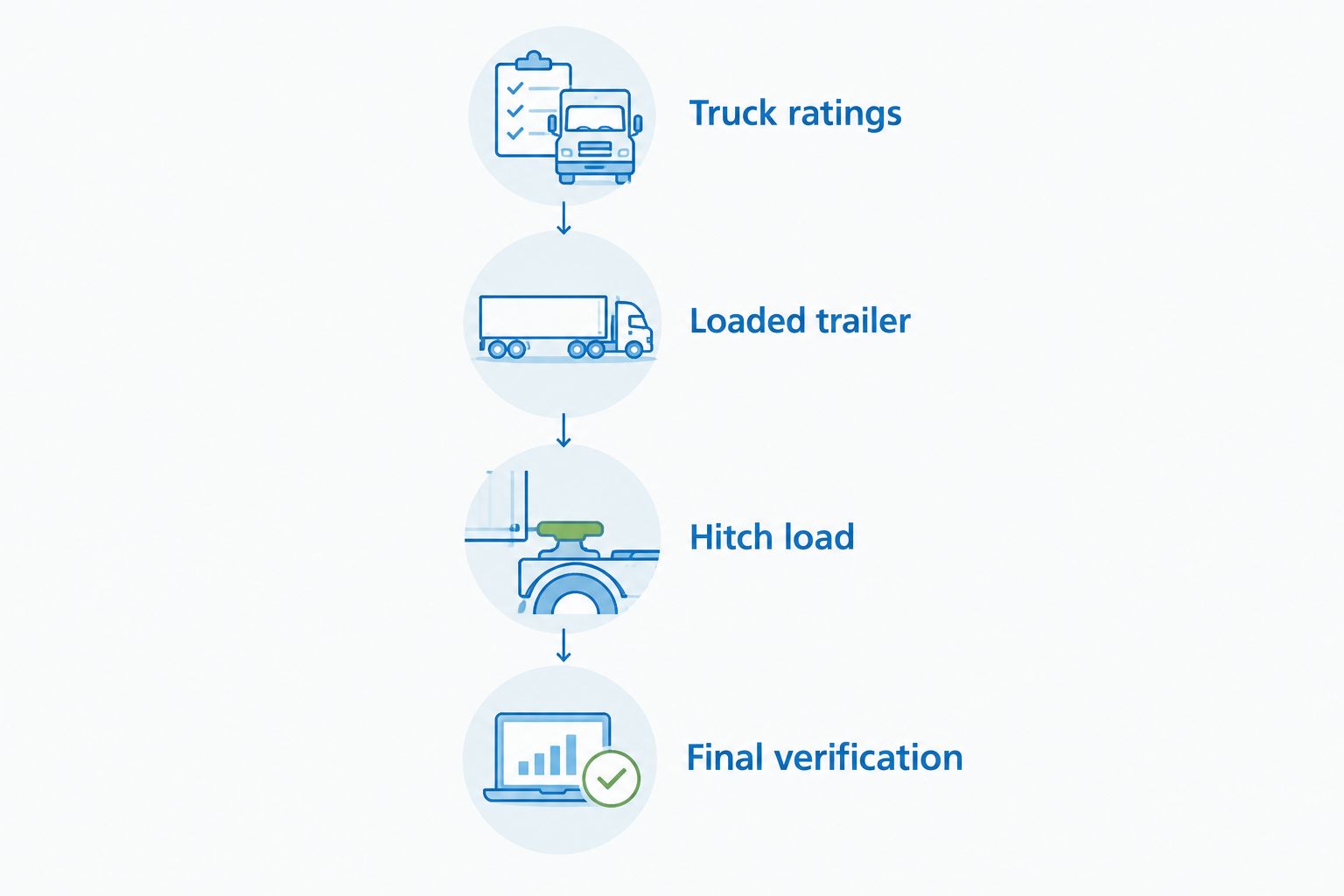
Use this sequence for a 2026 purchase:
- Truck ratings: Identify the truck’s towing, payload, axle, and combined-weight limits for its actual configuration.
- Loaded trailer: Account for camping equipment, water carried, personal belongings, and installed equipment.
- Hitch load: Include the hitch hardware and loaded pin weight when evaluating truck payload and axle loading.
- Final verification: Confirm the complete combination stays within every applicable rating; obtain actual loaded weights when practical.
If the fifth wheel does not fit your truck, change the trailer choice or evaluate a suitable truck before committing. Do not treat helper equipment as permission to exceed the vehicle manufacturer’s ratings.
How this ranking works
Rear bunkhouses rank first because this guide prioritizes permanent family beds and separation from the living room. Mid-bunks follow for families protecting lounge space; lofts, second bedrooms, and convertible rooms answer more specific needs.
The criteria are usable sleeping positions, towing compatibility, privacy, access, storage, and condition. This is a floorplan decision guide, not a claim that every example of one layout outperforms every example of another.
For a used fifth wheel, condition can outweigh layout preference. Arrange an appropriate inspection and verify roof, seals, appliances, slides, brakes, tires, and service records before deciding.
Which family bunkhouse fifth wheel should you choose?
Start with a rear bunkhouse with permanent beds and a closing door. Move to a mid-bunk if preserving the main lounge matters more, or a two-bedroom layout if separate sleeping groups need privacy.
Recreation USA offers new and used fifth wheels along with financing, trade-ins, parts, and service. Call the Myrtle Beach-area lots with your truck configuration, sleeper count, and preferred layout before planning a visit from Conway, elsewhere in the Carolinas, or a nearby state.
Ask for an itemized written quote and the terms of any financing proposal. Compare the exact unit, condition, equipment, and total purchase terms—not just the floorplan name or monthly payment.
Discuss your family's fifth wheel
Bring your truck details, sleeper count, and preferred layout to the Myrtle Beach-area team.
FAQ
What's the best fifth-wheel bunkhouse layout for a large family?
A rear bunkhouse with permanent beds and a closing door is the best starting point for a family that wants a dedicated children's room. Confirm that every bed fits its intended sleeper and that the loaded fifth wheel fits the truck's ratings.
Is a mid-bunk better than a rear bunkhouse?
A mid-bunk is better when keeping a separate main living area is your priority. A rear bunkhouse is the stronger starting point when a dedicated children's sleeping room matters most; compare the actual beds, storage, and access.
Can I choose a fifth wheel using dry weight?
No, dry weight alone does not establish towing compatibility. Check loaded trailer weight, loaded pin weight, hitch weight, truck payload, axle ratings, and the manufacturer's towing guidance.
Are loft beds suitable for young children?
Do not assume a loft bed is suitable for a young child. Follow the specific manufacturer's instructions and evaluate access, guardrails, weight limits, and the child's ability to use the space safely.
Does a bunkhouse fifth wheel always have a second bathroom?
No, a bunkhouse designation does not guarantee a second bathroom. Verify the exact floorplan and walk the route from every sleeping area to the bathroom.
Should I buy a new or used family fifth wheel?
Choose the unit that meets your family layout, towing, condition, and ownership requirements. A used fifth wheel needs a careful condition inspection; a new unit still requires equipment verification and an operating walkthrough.
Where can I discuss family fifth wheels near Myrtle Beach?
Recreation USA is a family-owned dealership with two lots in the Myrtle Beach, South Carolina area offering new and used fifth wheels. Call with your truck details, sleeping requirements, and trade-in questions so the conversation starts with your actual needs.
One last thing
Before signing for a fifth wheel in 2026, rehearse bedtime with every bed deployed. Have one person walk to the bathroom while another retrieves clothing and an adult reaches the children’s beds.
If ordinary bedtime tasks block the doorway or require moving another sleeper, choose a different layout. That walkthrough tells you something a sleeping-capacity label cannot.