

Best overall: a purpose-designed accessible travel trailer matched to your wheelchair. Best for equipment space: a professionally adapted travel-trailer toy hauler. Best used option: an already-adapted trailer that passes an access and condition inspection. This 2026 guide ranks buying approaches by usable access, not by an accessibility label alone.
- The best wheelchair accessible travel trailers fit your chair, transfers, bathroom routine, and tow vehicle together.
- Purpose-designed accessible travel trailers are the default choice when entry and interior access meet your needs.
- A toy-hauler ramp does not establish wheelchair access; slope, loading limits, and interior routes need checking.
- Recreation USA is best for local RV shoppers who want to discuss towing, trade-ins, financing, and service.
Why this matters
A wheelchair-friendly entrance is only the beginning. You also need to reach the bed, use the bathroom, move around furniture, and exit safely without relying on a setup that fails at the next campsite.
Recreation USA is a family-owned dealership with two Myrtle Beach-area lots, serving RV buyers from Conway, the Carolinas, and nearby states. Its wholesale-to-you pricing and no hidden freight or prep fees support a straightforward buying conversation; accessibility still needs a separate, chair-specific assessment.
Choose the trailer around your daily routine, then confirm towing—not the other way around. For your 2026 shortlist, separate features you need independently from tasks where you normally use assistance.
What makes the best wheelchair accessible travel trailers
Use these criteria before comparing layouts:
- Entry access: Check clear opening width, thresholds, ramp or lift operation, landing space, and the equipment's documented loading limits.
- Interior movement: Confirm that your wheelchair can pass furniture, turn where necessary, and reach the exit with the trailer configured for camping.
- Bathroom access: Evaluate the doorway, toilet transfer, shower entry, support locations, and space for assistance if required.
- Sleeping and controls: Check bed transfers, reachable switches, heating controls, outlets, storage, and emergency-release mechanisms.
- Towing and payload: Account for accessibility equipment, batteries, water, belongings, and wheelchair transport when checking vehicle and trailer limits.
- Serviceability: Require documentation for modifications and identify who can service the ramp, lift, restraints, and altered systems.
Dimensions are screening tools, not proof of suitability
The U.S. Access Board's 2010 ADA Standards specify a minimum 32 inches of clear door opening in applicable accessible building conditions and a 60-inch diameter for a circular turning space. Those building dimensions provide useful reference points; they do not certify a recreational trailer as accessible or establish that your chair will fit.
The same standards generally limit accessible ramp running slope to 1:12 in covered building applications. That means 1 inch of rise for 12 inches of horizontal run. Do not treat those dimensions as instructions for modifying an RV ramp: trailer height, equipment instructions, landing conditions, and your mobility needs require a separate assessment.
Measure your own chair and test your own movements. Door hardware, armrests, footplates, transfer equipment, and a companion's working space can make a nominally wide layout unusable.
Accessible travel trailer options at a glance
This ranking compares purchase approaches rather than treating every trailer within a category as wheelchair-accessible. Each option needs an individual inspection before it earns a place on your 2026 buying list.
| Rank and option | Best for | Standout feature | Key limitation |
|---|---|---|---|
| 1. Purpose-designed accessible travel trailer | Buyers needing an integrated access layout | Entry and living arrangements planned together | The actual layout must still fit your chair and transfers |
| 2. Professionally adapted travel-trailer toy hauler | Buyers needing wheelchair and equipment space | Garage area offers a separate space to evaluate | Cargo ramps and garage access do not establish bathroom access |
| 3. Already-adapted used travel trailer | Buyers evaluating an existing conversion | You can inspect the completed arrangement | Modification history and equipment condition need verification |
| 4. Conventional travel trailer with a planned conversion | Buyers needing a highly specific layout | Requirements can guide the proposed work | Structural, weight, and system constraints can rule it out |
1. Purpose-designed accessible travel trailer: best for integrated access
A purpose-designed accessible travel trailer puts access requirements into the layout from the start. Evaluate the entry system, circulation route, bathroom, and sleeping area as one connected arrangement—not as separate features on a brochure.
This is the strongest starting point when you need predictable movement between essential spaces. It is not an automatic recommendation for every wheelchair user: a layout suited to someone who transfers independently can fail someone who uses a hoist or needs assistance on both sides of the bed.
Purpose-designed accessible travel trailer pros:
- Access features can be evaluated as part of the complete floorplan.
- Entry, sleeping, and bathroom needs can be checked together.
- Specified access equipment gives you concrete documentation to review.
Purpose-designed accessible travel trailer cons:
- An accessible designation does not describe your personal transfer needs.
- Fixed furniture or bathroom geometry can still restrict movement.
- Specialized entry equipment needs its own maintenance plan.
Best for: Buyers who want entry and daily living considered together, including full-time travelers and campers who need independent access.
For a 2026 purchase, ask for the exact trailer's drawings and equipment documentation. Then conduct a walkthrough using your wheelchair and normal assistance arrangements, rather than relying on another person's demonstration.
Verdict: Buy only after the complete route from entrance to bathroom and bed works for you.
2. Adapted travel-trailer toy hauler: best for equipment space
A travel-trailer toy hauler provides a garage area and a cargo-loading arrangement. Those features make it a useful candidate for professional assessment when you need room for a wheelchair, mobility equipment, or a flexible living setup.
However, a cargo ramp is not automatically a wheelchair ramp. Evaluate its slope, surface, transitions, loading limits, and approved use, then inspect the route from the garage into the rest of the trailer.
Adapted travel-trailer toy hauler pros:
- The garage offers a separate area to assess for equipment and movement.
- Removable furniture can be evaluated for a less obstructed layout.
- Equipment storage and living needs can be considered in distinct zones.
Adapted travel-trailer toy hauler cons:
- Garage access does not solve a narrow bathroom or raised bedroom.
- Ramp geometry depends on trailer setup and the ground beneath it.
- Conversion equipment and carried cargo consume payload.
Best for: Campers who need equipment space and can verify that the living area supports their personal care routine.
Check what happens when beds, seating, and tables are deployed. A usable empty garage can become an obstructed room once everyone settles in for the evening; your emergency exit route must remain usable.
Verdict: Hold until a qualified conversion professional confirms entry, interior access, and weight implications.
3. Already-adapted used travel trailer: best for inspecting a finished setup
An already-adapted used travel trailer lets you assess completed work rather than a proposal. You can inspect the installed entry system, try the interior route, and see whether the bathroom and sleeping arrangements match your needs.
Treat the conversion and the underlying RV as separate inspection subjects. A workable wheelchair layout does not compensate for water damage, worn running gear, or undocumented alterations.
Already-adapted used travel trailer pros:
- The actual conversion is available for hands-on evaluation.
- You can test transfers and reach before deciding.
- Existing equipment labels and records provide inspection starting points.
Already-adapted used travel trailer cons:
- Previous modifications can suit the prior owner's needs rather than yours.
- Missing records make structural and electrical changes harder to assess.
- Older access equipment requires condition and service checks.
Best for: Used-RV and trade-in shoppers who find a completed layout that already fits their routine.
Ask who performed the work, what components were installed, and where the equipment can be serviced. Inspect floor and wall changes around openings, equipment mounts, plumbing, and wiring with professionals qualified for those systems.
Verdict: Buy only after both the RV inspection and the accessibility-equipment inspection pass.
4. Planned travel trailer conversion: best for highly specific requirements
A conventional travel trailer with a planned conversion starts with your requirements and a professional feasibility review. Possible work must be evaluated against the trailer's structure, layout, systems, and weight limits before you commit to the base RV.
This approach is appropriate when existing arrangements do not match your transfers or equipment. It demands a documented plan; buying first and asking whether a doorway can be widened later reverses the decision process.
Planned travel trailer conversion pros:
- Your wheelchair and personal care routine can guide the requirements.
- Furniture placement and control reach can be considered together.
- A written scope separates required work from optional changes.
Planned travel trailer conversion cons:
- Walls, tanks, wheel wells, and chassis components restrict alterations.
- Added equipment changes weight and payload calculations.
- Warranty implications and responsibility for future repairs need clarification.
Best for: Buyers with specific requirements who can secure professional feasibility approval before purchasing.
Do not assume that a larger trailer is easier to adapt. Examine the actual floorplan, structural drawings where available, and proposed equipment locations; extra overall length does not establish a usable bathroom.
Verdict: Wait until the conversion scope and towing calculations are documented.
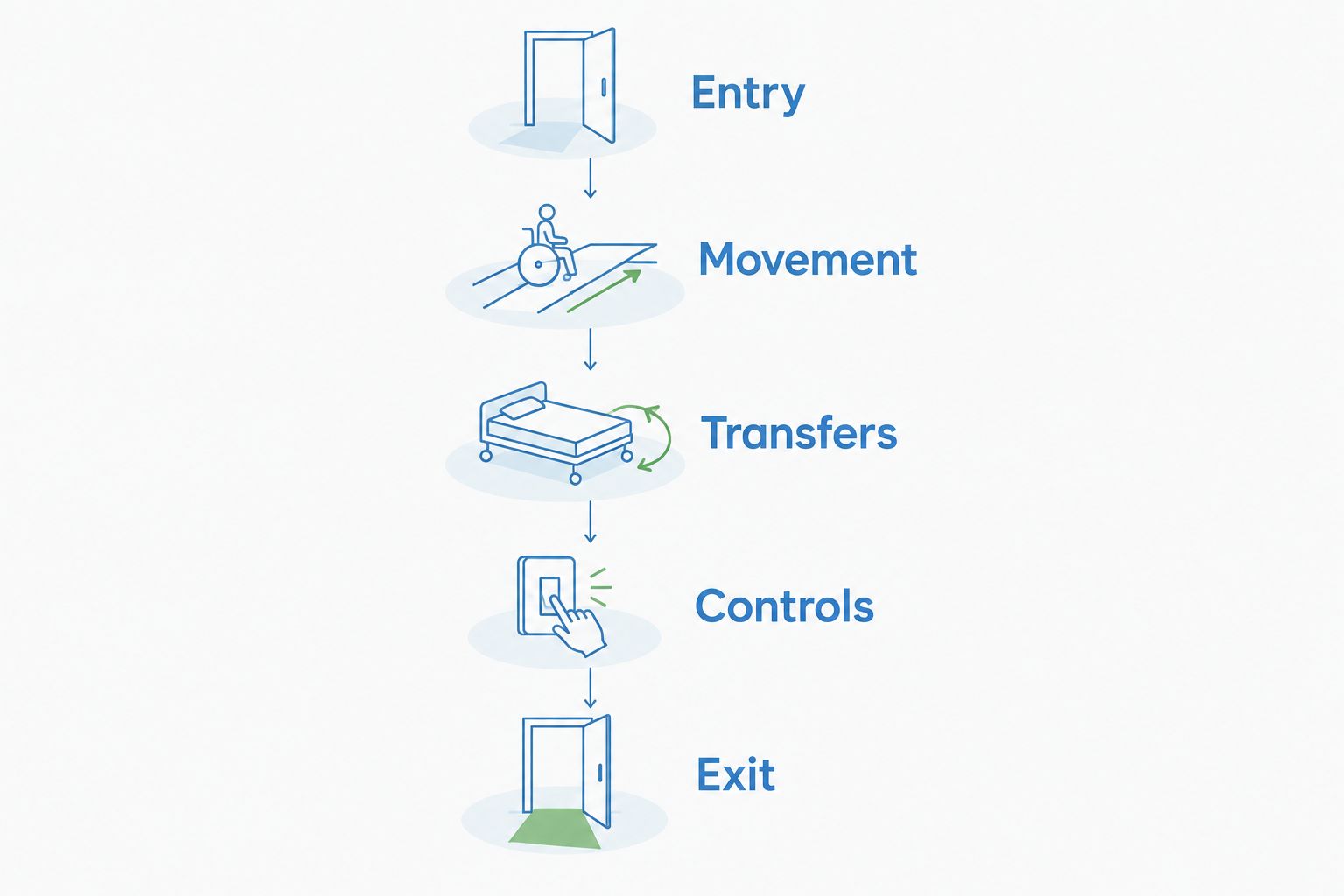
Test the trailer in the order you use it
For a 2026 lot visit, bring your wheelchair, essential transfer equipment, and the person who normally assists you. Ask permission before operating entry equipment and follow its instructions throughout the evaluation.
- Entry: Check the approach, clear opening, threshold, and approved ramp or lift operation.
- Movement: Follow the route to the kitchen, seating, bathroom, bed, and exit without moving furniture you need in use.
- Transfers: Reproduce your normal bed and toilet approach, including space for assistance.
- Controls: Reach lights, heating controls, outlets, storage, and necessary handles from your normal position.
- Exit: Review how you would leave if the powered entry equipment stopped working.
An unsuccessful step is a reason to stop and reassess, not something to dismiss because the rest of the trailer looks right. Ask a qualified professional about alternatives before accepting a workaround.
Check towing after confirming the layout
Accessibility equipment belongs in your loaded-weight assessment. Confirm the trailer's weight ratings, actual loaded weight, tongue weight, tow-vehicle payload, hitch limits, and the ratings of any lift or ramp involved.
Do not select a tow vehicle by a trailer's dry weight alone. The guide to lightweight travel trailers for half-ton trucks provides a related starting point, but your specific vehicle and loaded trailer still need their own checks.
Recreation USA can discuss travel trailer towing, trade-ins, financing, parts, and service. Call its Myrtle Beach-area lots with your vehicle details and access requirements; confirm separately who will assess or perform accessibility work.
How the options are ranked
The ranking prioritizes integrated entry and interior access, followed by the ability to inspect a finished arrangement. Equipment space and customization matter only when bathroom access, transfers, safe operation, and towing also work.
No option wins because it is simply longer, newer, or described as accessible. The strongest choice is the exact trailer that supports your routine with documented equipment and a usable exit plan.
Which accessible travel trailer should you choose?
Start with a purpose-designed accessible travel trailer. If its bathroom or sleeping layout fails your requirements, assess a professionally adapted toy hauler or an already-adapted used trailer before pursuing a new conversion.
Recreation USA is best for local travel trailer shoppers who want to discuss towing, trade-ins, financing, and service. For your 2026 visit, describe required clearances, transfers, assistance, and equipment—not just a preferred trailer length.
Request written purchase terms and compare the complete ownership plan, including any proposed conversion and access-equipment servicing. Financing approval is separate from trailer suitability; neither replaces the other.
FAQ
What's the best wheelchair accessible travel trailer?
The best starting point is a purpose-designed accessible travel trailer that fits your wheelchair, bathroom routine, bed transfers, and tow vehicle. Verify the exact trailer with a hands-on assessment before buying.
Is a toy hauler automatically wheelchair-accessible?
No, a toy hauler's cargo ramp does not establish wheelchair accessibility. Check approved ramp use, slope, transitions, loading limits, and access to the bathroom and sleeping area.
Can I convert a regular travel trailer for wheelchair access?
A conventional travel trailer needs a professional feasibility review before an accessibility conversion. Structure, plumbing, electrical systems, layout, and weight limits determine what work is practical.
How wide should a wheelchair-accessible trailer doorway be?
The doorway must provide enough clear opening for your actual wheelchair and entry movement. The 2010 ADA Standards use 32 inches as a minimum clear opening in applicable building conditions, but that is not proof that an RV doorway fits your needs.
Are used wheelchair-accessible travel trailers a good choice?
An already-adapted used trailer is a good candidate when its layout fits you and its condition and modifications pass inspection. Verify equipment records, service options, structural changes, and the underlying RV's condition.
How much does a wheelchair-accessible travel trailer cost?
Request a current written quote for the exact trailer and any required accessibility work. Compare the purchase terms, conversion scope, financing terms, and ongoing equipment-service needs rather than relying on a general advertised figure.
Can Recreation USA help with an accessible travel trailer search?
Recreation USA sells new and used RVs and offers financing, trade-ins, parts, and service in the Myrtle Beach area. Call with your wheelchair requirements and tow-vehicle details, and confirm who will assess any accessibility modifications.
One last thing
Test the bathroom before falling in love with the living room. Entry equipment gets attention, but your toilet and bed transfers determine whether the trailer supports daily life. A spacious lounge cannot fix a bathroom you cannot use.