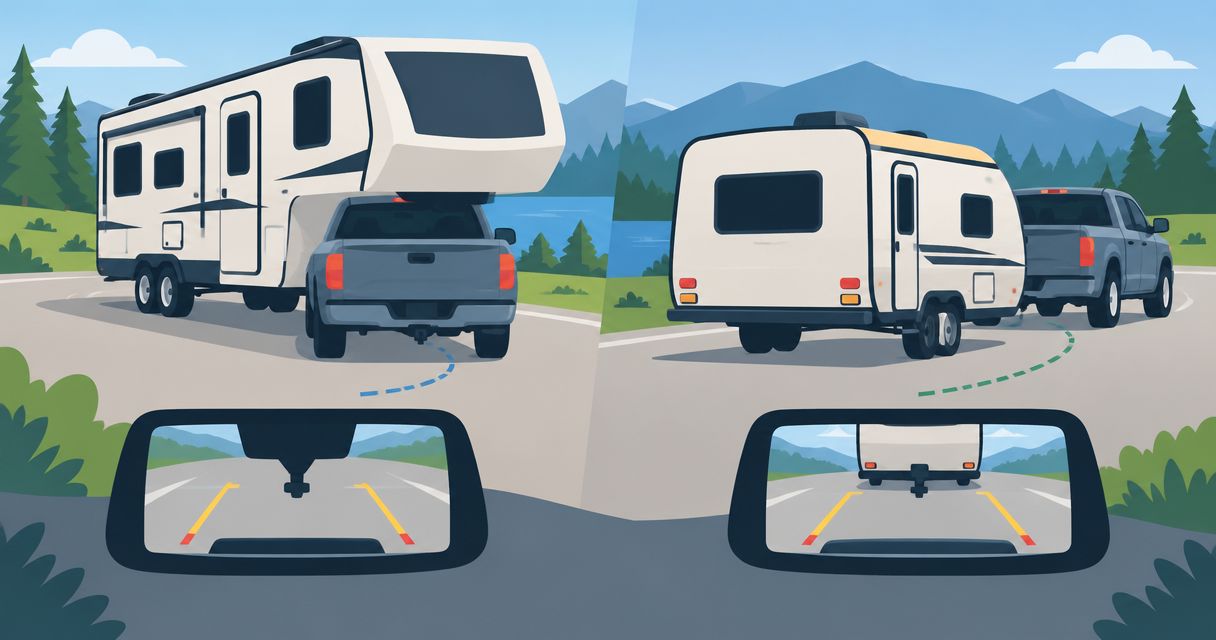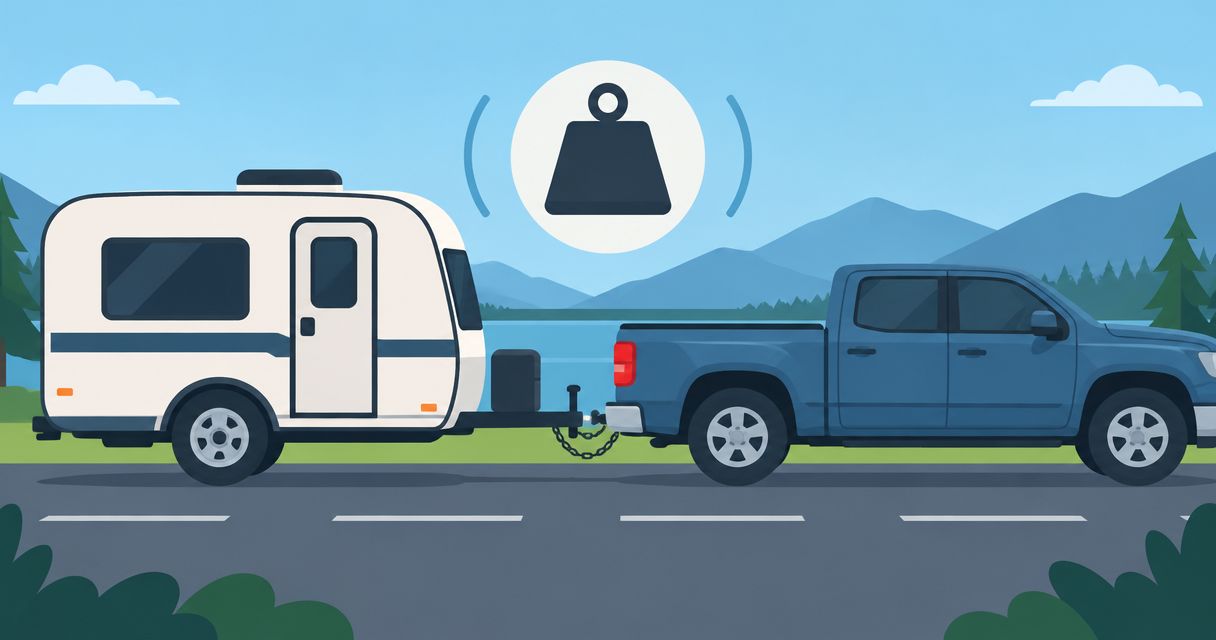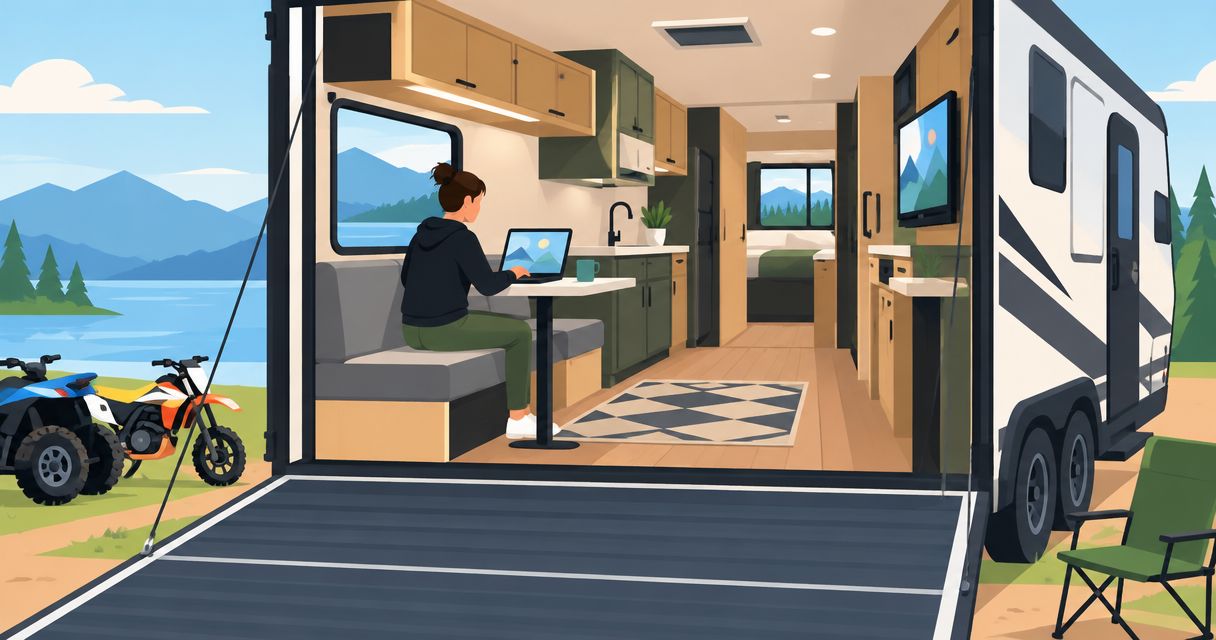
Best overall: a compact rear-bath travel trailer; best for families: a compact bunkhouse; best for simple campsite setup: a no-slide trailer. This 2026 guide ranks the best travel trailers under 30 feet by floorplan type for national park camping, with towing and campsite checks that come before choosing a particular unit.
- The best travel trailers under 30 feet match your campsite, loaded towing limits, and sleeping needs—not just a floorplan name.
- Choose a compact rear-bath travel trailer for couples; choose a compact bunkhouse when children need dedicated beds.
- Choose a no-slide travel trailer when usable interior space without slide deployment is your priority.
- Recreation USA is a family-owned RV dealership for Myrtle Beach-area buyers comparing new and used travel trailers.
Why this matters
A trailer under 30 feet is not automatically suitable for every national park campsite. The reservation’s equipment limits, approach roads, parking layout, and space for your tow vehicle still decide whether it fits.
For buyers around Myrtle Beach, Conway, and the Carolinas, Recreation USA offers new and used travel trailers, financing, trade-ins, parts, and service. The practical starting point is your tow vehicle and camping plans—not the largest floorplan you can bring home.
For your 2026 shortlist, treat the picks below as floorplan recommendations, not verified model specifications. Confirm the exact trailer’s exterior length, weight ratings, equipment, and condition before committing.
What makes the best travel trailer under 30 feet?
Use these criteria before comparing interior finishes:
- Measured exterior length: Confirm the manufacturer’s overall length for the exact unit. A floorplan number is not a measurement, and body length alone does not settle campsite fit.
- Loaded towing fit: Compare the trailer’s ratings and expected loaded weight with your vehicle’s towing, payload, axle, and hitch limits. Dry weight is only a starting point.
- Useful sleeping space: Give each regular camper a workable bed. Check whether someone must convert the dinette every night.
- Campsite footprint: Account for slide-outs, entry steps, utility connections, and where the tow vehicle parks. Length is not the only dimension that matters.
- Camping systems: Match water storage, battery equipment, heating, and waste handling to the hookups and facilities at your destination.
- Ownership condition: Inspect tires, seals, roof, appliances, and maintenance records. This matters for both new and used travel trailers.
Reject a trailer that fails the towing or campsite check, even if its floorplan is your favorite. Neither a comfortable sofa nor an extra bunk fixes an unsuitable combination.
Best travel trailers under 30 feet at a glance
| Ranked floorplan type | Best for | Standout feature to seek | Key limitation |
|---|---|---|---|
| Compact rear-bath trailer | Couples taking varied park trips | Permanent bed with a separate bathroom | Usually less suitable for several dedicated sleeping spaces |
| Compact bunkhouse trailer | Families with children | Dedicated bunks alongside the main bed | Bunks compete with living and storage space |
| No-slide trailer | Straightforward setup in constrained sites | Usable interior without slide deployment | Less expanded living space |
| Rear-dinette trailer | Travelers who spend time eating or working inside | Seating beside rear windows | Bed conversion can interrupt the daily routine |
| Twin-bed trailer | Travel partners wanting separate beds | Independent sleeping spaces | Less suitable for buyers wanting one shared bed |
These layouts can overlap. Rank the exact unit by its main benefit, then verify that its actual exterior length is under 30 feet; do not assume every trailer with these layouts qualifies.
1. Compact rear-bath trailer: best for couples on varied park trips
A compact rear-bath travel trailer puts the bathroom at the rear, leaving the remaining interior for sleeping, cooking, and seating. For couples, look for a permanent main bed so meals and bedtime do not require rearranging the same furniture.
This is the default pick because it addresses everyday needs without making extra sleeping capacity the priority. During a walkthrough, check whether both travelers can reach their side of the bed and whether the bathroom door interferes with the aisle.
Compact rear-bath trailer pros:
- A permanent bed keeps the dining area available.
- A separate bathroom gives you a private changing space.
- A couples-focused layout lets you prioritize useful storage over extra bunks.
Compact rear-bath trailer cons:
- Guest beds often depend on convertible furniture.
- A larger bathroom takes space from another part of the trailer.
- Bed access varies; inspect it rather than assuming it is walk-around.
Best for: Couples, first-time buyers, and seasonal travelers whose usual trips do not require dedicated children’s beds.
Recreation USA travel trailer buyers should ask to compare the actual bed access, bathroom clearance, and storage—not just similar floorplan drawings. A used unit with the right layout deserves the same towing and condition checks as a new one.
Verdict: Buy this layout if a permanent bed and practical bathroom matter more than extra sleeping capacity.
2. Compact bunkhouse trailer: best for families with children
A compact bunkhouse gives children dedicated sleeping spaces instead of assigning the dining area to bedtime. That distinction matters when one person wants to sleep while others still need the table.
For a 2026 family camping plan, check bunk dimensions and the stated bunk weight limits on the exact trailer. Also inspect the route from each bed to the bathroom: a good sleeping count does not guarantee an easy nighttime routine.
Compact bunkhouse trailer pros:
- Dedicated bunks reduce daily furniture conversion.
- Children can keep bedding in their own sleeping area.
- Separate main and bunk beds support different bedtime schedules.
Compact bunkhouse trailer cons:
- Bunks occupy space that another layout uses for seating or storage.
- Upper-bunk access needs a hands-on check.
- More passengers and camping gear add to the towing combination’s load.
Best for: Families who need regular children’s beds rather than occasional guest accommodation.
Put shoes, coats, food, outdoor chairs, and bedding on your storage checklist. A family floorplan needs places for the family’s belongings, not just places for people to sleep. Check exits and follow the manufacturer’s instructions for bunk use.
Verdict: Buy this layout when dedicated bunks solve a real nightly problem; skip it when they would mostly hold luggage.
3. No-slide trailer: best for straightforward campsite setup
A no-slide travel trailer keeps its interior within a fixed body footprint. You do not need to extend a slide to use the layout, making the setup decision simpler when a site has nearby trees or a constrained parking area.
That does not make the trailer universally campsite-friendly. Entry steps, doors, utility connections, and the tow vehicle still need space, and the campground’s length restrictions still apply.
No-slide trailer pros:
- Interior use does not depend on deploying a slide.
- There is no slide mechanism to operate or maintain.
- The walkthrough shows the same basic living footprint you will use at camp.
No-slide trailer cons:
- Living space does not expand after parking.
- Narrow aisles need careful checking with everyone inside.
- Fixed furniture can limit how you move through the trailer.
Best for: Buyers who value straightforward setup more than expanded lounge space.
Walk through the trailer together. Open the refrigerator and bathroom doors, stand at the kitchen counter, and check whether another person can pass. This reveals more than viewing the interior from the doorway.
For your 2026 shortlist, choose a no-slide layout because its fixed space works for you—not because you assume it is lighter or suitable for every tow vehicle.
Verdict: Buy this layout if the interior works as parked; skip it if the aisle already feels restrictive during the walkthrough.
4. Rear-dinette trailer: best for meals and indoor downtime
A rear-dinette travel trailer places the eating area at the back of the camper. When that seating sits beside rear windows, it creates a place to eat, read, or work while looking outside.
The deciding question is whether the dinette also serves as your main bed. Converting it can be acceptable for occasional trips, but it changes the routine when bedding must be cleared before breakfast.
Rear-dinette trailer pros:
- A defined dining area supports meals and indoor activities.
- Rear windows give seated occupants an outside view.
- Convertible seating offers another sleeping arrangement when the unit provides it.
Rear-dinette trailer cons:
- Bed conversion adds a recurring setup task.
- Cushions and table supports need inspection for sleeping comfort.
- The rear view depends on how the campsite positions the trailer.
Best for: Campers who prioritize a useful indoor table and seating area.
Test the table height, seat depth, and access before deciding. If the dinette converts, complete the conversion during the walkthrough and check where the table and bedding go. Do not judge a sleeping surface solely from the daytime arrangement.
Verdict: Buy this layout if the dinette improves how you spend time inside; hold if the nightly conversion feels inconvenient.
5. Twin-bed trailer: best for travel partners wanting separate beds
A twin-bed travel trailer provides separate sleeping spaces rather than one shared main bed. It suits friends, relatives, or couples who prefer that arrangement.
Look closely at the bed lengths, aisle clearance, and nearby storage. Separate beds are useful only when each traveler can sleep comfortably and reach everyday items without blocking the other person.
Twin-bed trailer pros:
- Each traveler has an independent sleeping space.
- Bedding can remain on separate permanent beds.
- A central aisle, where provided, creates a distinct route between beds.
Twin-bed trailer cons:
- The arrangement does not suit every couple.
- Separate mattresses need separate fit and comfort checks.
- Guest sleeping capacity depends on the rest of the layout.
Best for: Travel partners who specifically want separate beds.
Do not assume a twin-bed layout converts into a larger shared bed. Verify that feature on the exact unit if it matters to you. Likewise, inspect any storage beneath the beds and check whether accessing it requires moving bedding or lifting a platform.
Verdict: Buy this layout when separate beds are a requirement; skip it when a shared bed is your clear preference.
Check towing and campsite fit before choosing
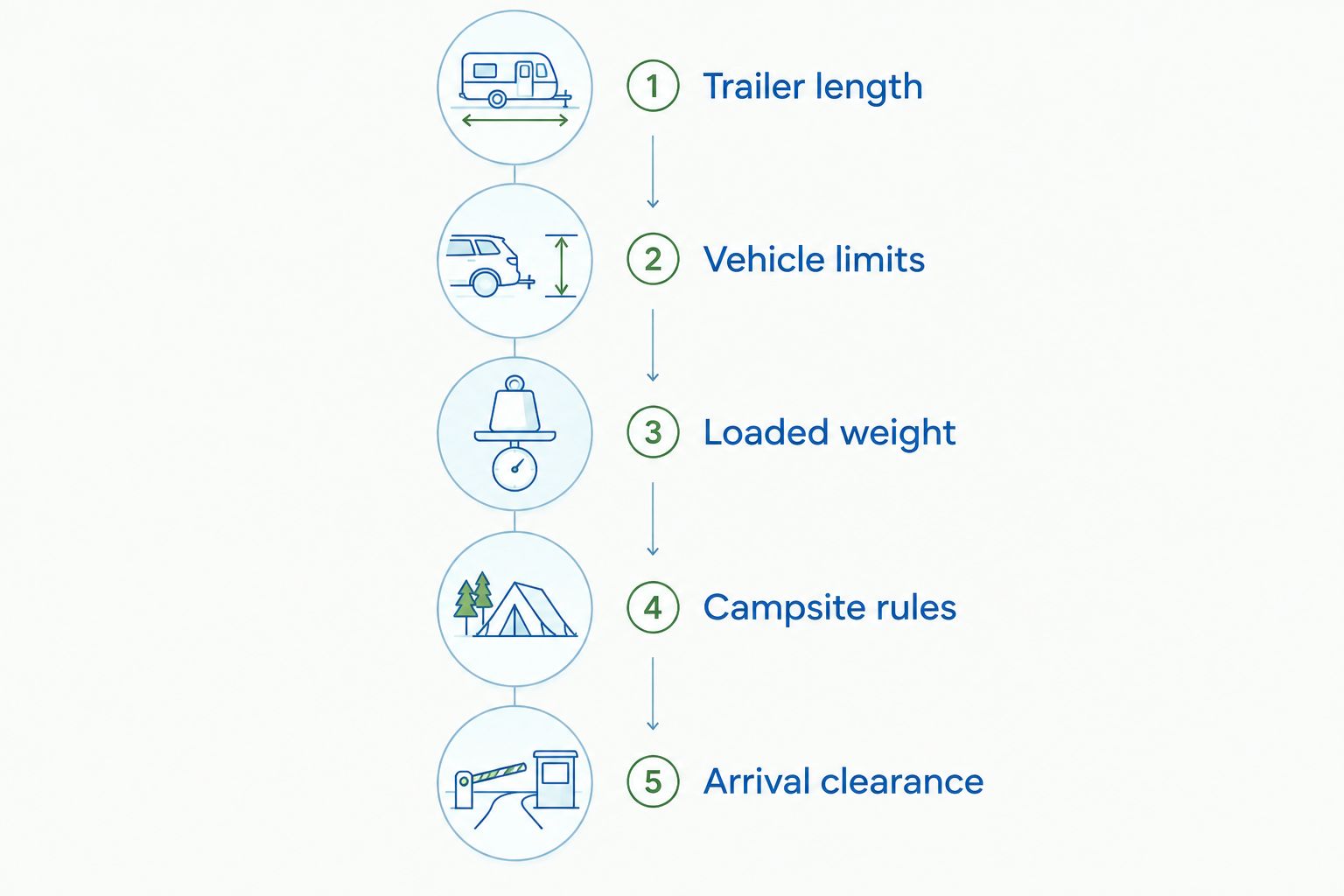
For national park camping in 2026, use this sequence before discussing financing or trading in your current RV:
- Trailer length: Get the exact overall exterior measurement. Keep that measurement separate from any model number or interior floor length.
- Vehicle limits: Read your tow vehicle’s documentation and vehicle-specific labels. Check towing, payload, axle, and hitch limits rather than relying on a truck class alone.
- Loaded weight: Account for passengers, cargo, installed accessories, hitch equipment, and the trailer’s loaded tongue weight. Do not use dry weight as the final towing decision.
- Campsite rules: Read the official reservation details for your actual site. Confirm how the campground defines equipment length and whether the tow vehicle must share the parking space.
- Arrival clearance: Check access restrictions and the room needed for steps, slides, and connections. Resolve uncertain requirements with the campground before reserving.
If your trips include camping without hookups, inspect the unit’s water, waste, and electrical systems separately. Battery equipment does not automatically support every appliance, and a campground stay does not guarantee access to water or a dump station.
Buying new or used around Myrtle Beach
Recreation USA is family-owned and local, with two lots in the Myrtle Beach area. Its wholesale-to-you approach and no hidden freight or prep fees give you a clear starting point for asking about the transaction.
Request an itemized purchase proposal for the exact unit. Review taxes, title costs, optional products, trade-in terms, and financing terms separately; do not judge the purchase by a monthly payment alone.
For a used trailer, inspect maintenance records and arrange a condition assessment. For any trailer, ask for a walkthrough of appliances, safety equipment, roof and seals, and hitch requirements. Financing approval is not a substitute for a suitable towing combination.
Compare trailers for your camping plans
Discuss towing, floorplans, trade-ins, and service with the Myrtle Beach-area dealership.
How these floorplans are ranked
The ranking prioritizes campsite fit, loaded towing suitability, sleeping arrangements, usable space, and ownership checks. It is a decision guide between layouts, not a claim that a particular model has passed a road test.
Compact rear-bath trailers take the default position for couples. Bunkhouses move first for families needing dedicated beds; no-slide layouts move first when fixed-footprint usability is the main requirement.
Which travel trailer should you choose?
Choose a compact rear-bath trailer unless your sleeping needs or setup preferences point elsewhere. Move to a bunkhouse for children’s beds, a no-slide layout for fixed-footprint use, a rear dinette for indoor seating, or twin beds for separate sleeping.
Recreation USA travel trailer shoppers should bring their tow vehicle details and intended campground requirements when calling the Myrtle Beach-area lots. That turns a broad shopping conversation into a practical shortlist.
FAQ
What's the best travel trailer under 30 feet for national park camping?
A compact rear-bath trailer is the default floorplan choice for couples; a compact bunkhouse is the better choice when children need dedicated beds. Confirm the exact unit's exterior length, loaded towing fit, and campsite requirements before buying.
Will every travel trailer under 30 feet fit in a national park campground?
No, being under 30 feet does not guarantee campsite fit. Check the specific site's equipment limits, access restrictions, parking arrangement, and clearance for steps or slides.
Does the model number tell me how long a travel trailer is?
No, a model number is not a reliable exterior-length measurement. Use the manufacturer's specifications for the exact unit and confirm what the stated measurement includes.
Can my half-ton truck tow a travel trailer under 30 feet?
Trailer length alone cannot determine whether your half-ton truck can tow it. Check the truck's vehicle-specific towing, payload, axle, and hitch limits against the loaded combination.
Is a no-slide travel trailer better for national park camping?
A no-slide trailer is better when you want interior use without extending a slide. It still needs suitable towing capacity and enough campsite space for the trailer, steps, connections, and tow vehicle.
Should I choose a bunkhouse or rear-bath travel trailer?
Choose a bunkhouse when children need dedicated beds; choose a rear-bath layout when a couple's everyday comfort is the priority. Walk through both layouts and check storage, bed access, and bathroom access.
Is buying a used travel trailer a good option?
A used travel trailer is an option when its layout, towing requirements, and condition suit your needs. Inspect maintenance records, roof and seals, tires, appliances, and safety equipment before committing.
One last thing
Read the campsite reservation before falling in love with the floorplan. A trailer can meet your under-30-foot requirement and still conflict with the site’s parking arrangement. Save the official site details alongside the exact trailer specifications so you compare the same requirements throughout your search.